Posted on April 28, 2026
Gunstar Heroes: Pure Run-and-Gun Joy on the Sega Genesis
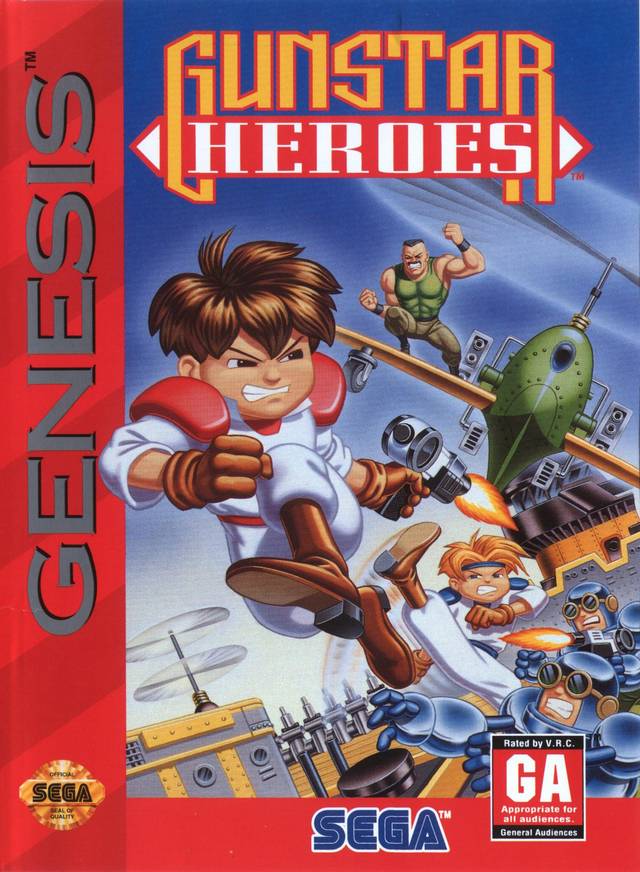
Remember when you’d rent a game based purely on the box art?
You’re standing in the video store, Saturday afternoon stretching out in front of you like a blank canvas. Mom said you could pick one game. Just one. And there it is on the shelf: Gunstar Heroes. Two characters doing sick flips through the air, guns blazing, everything exploding in sixteen different directions at once. The tagline promises “non-stop action.”
You grab it. You don’t even read the back. You just know.
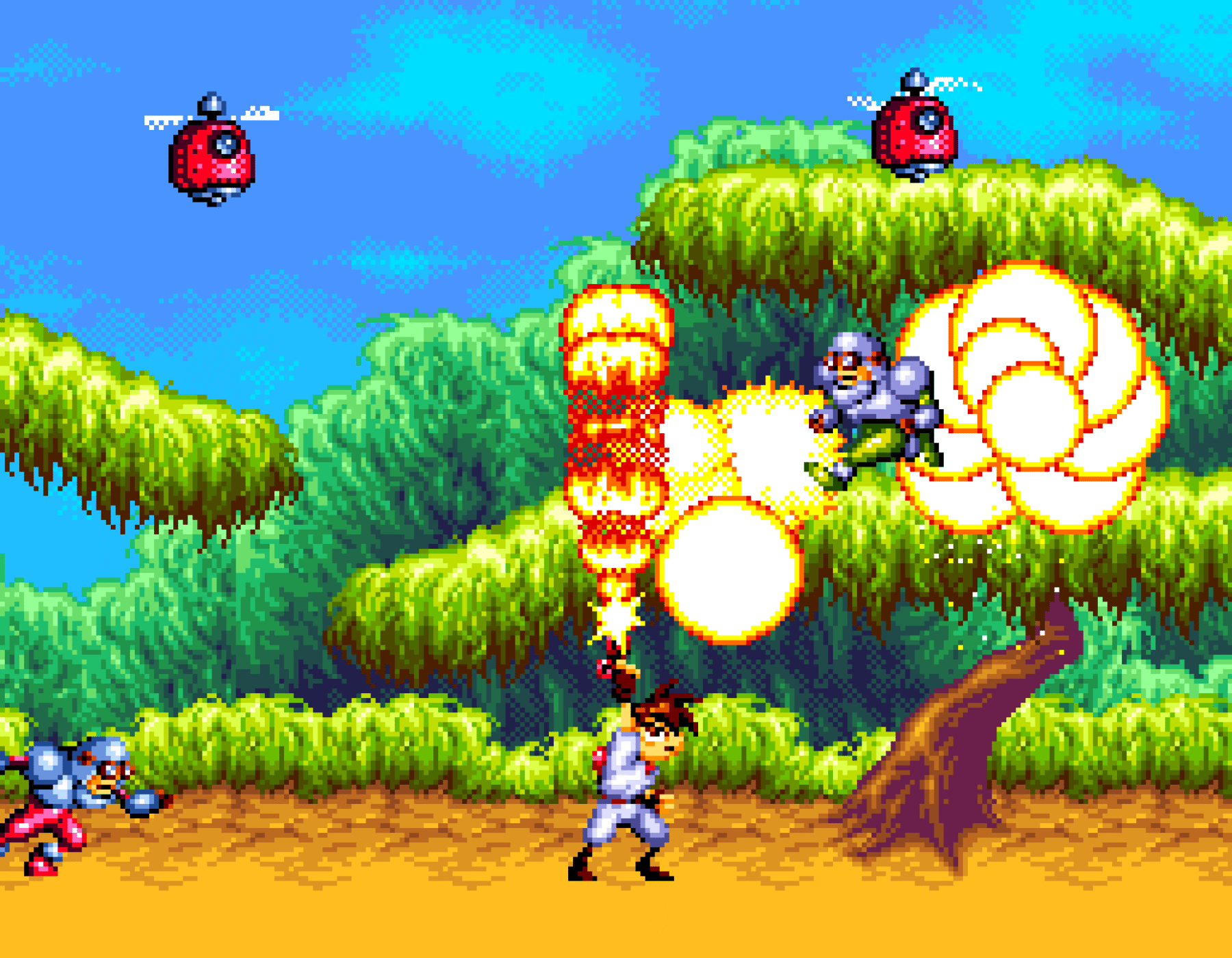
And then you get home, pop that cartridge in, and the opening level hits you like a freight train made of fireworks. Within thirty seconds, you’re grinning so hard your face hurts. By the time you’re riding a minecart through a collapsing mine while bosses attack from every angle, you’re convinced you just found the best game on the Genesis.
That instinct? Dead right.
Gunstar Heroes didn’t just deliver on its promise of non-stop action—it redefined what that phrase could mean on a 16-bit console. This was Treasure’s debut game, and they came out swinging like they had something to prove.
Spoiler: They absolutely did.
At a Glance
- Platform: Sega Genesis / Mega Drive
- Developer: Treasure (their legendary first game)
- Genre: Run-and-Gun / “Controlled Chaos Simulator”
- Players: 1-2 (and co-op is basically mandatory)
- Vibe: Saturday morning cartoon meets Michael Bay’s fever dream
- You’ll Love It If: You want pure, distilled fun with a friend
- Maybe Skip If: You need deep story or slow, methodical gameplay
- Best Way to Play: Genesis hardware, Sega Genesis Classics collection, or quality emulation—preferably with a buddy on the couch
Why This Game Grabbed You By the Collar and Never Let Go
Let’s get something straight right away: Gunstar Heroes doesn’t ease you into anything.
Most games have a tutorial level. A warm-up. Some gentle hand-holding while you figure out the controls.
Gunstar Heroes throws you into a war zone, hands you four different weapon types that you can combine into dual-weapon hybrids, and immediately starts pelting you with enemies, explosions, and environmental hazards from every conceivable direction.
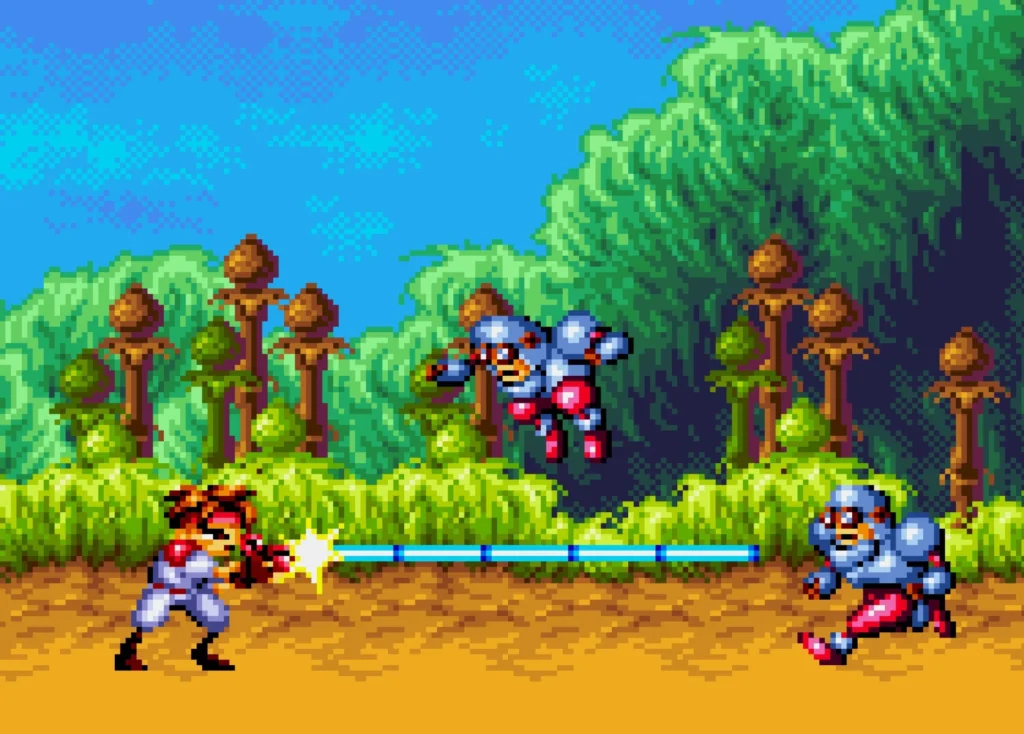
And it feels incredible.
Because here’s what Treasure understood that a lot of developers didn’t: chaos is only fun when you feel in control of it. And in Gunstar Heroes, you’re not just surviving the chaos—you’re conducting it like a symphony of violence.
The Weapons System Was Genius (And You Probably Discovered It By Accident)
Four base weapons. Simple enough, right?
- Force (laser beam)
- Lightning (electricity that chains between enemies)
- Chaser (homing shots)
- Flame (short-range devastation)
But here’s the magic: you could combine any two of them.
Force + Lightning? Electric laser. Chaser + Flame? Homing fireballs. Lightning + Lightning? Pure concentrated mayhem.
Remember the first time you figured this out? You probably grabbed two random weapons thinking you’d switch between them, and then suddenly you’re firing some unholy hybrid weapon you didn’t know existed, and enemies are just melting.
That moment of discovery—that’s what made this game special. It didn’t explain the system to you in excruciating detail. It just let you play and find your favorite combinations through experimentation and pure joy.
The Bosses Were Absolutely Unhinged
We need to talk about Seven Force.
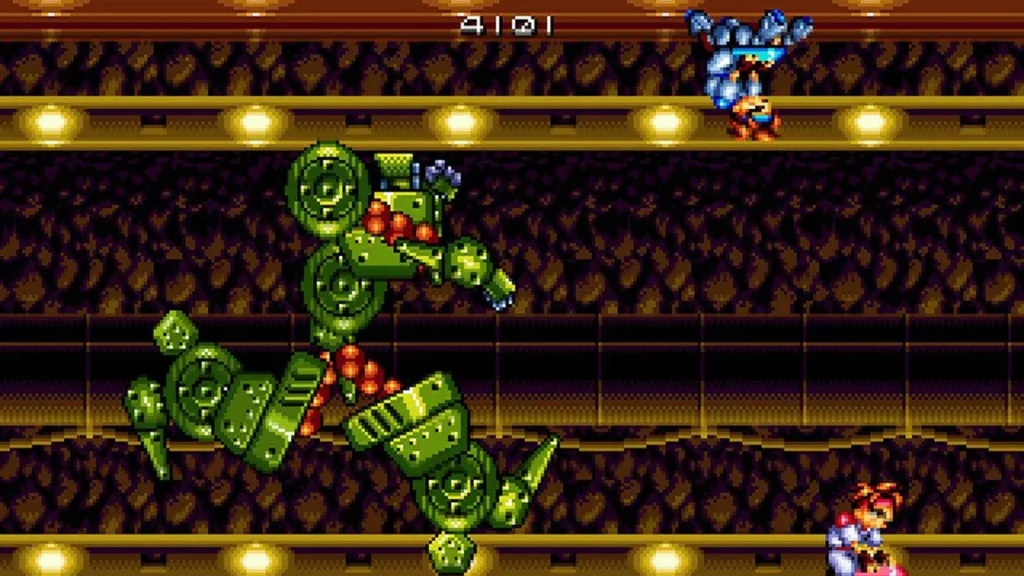
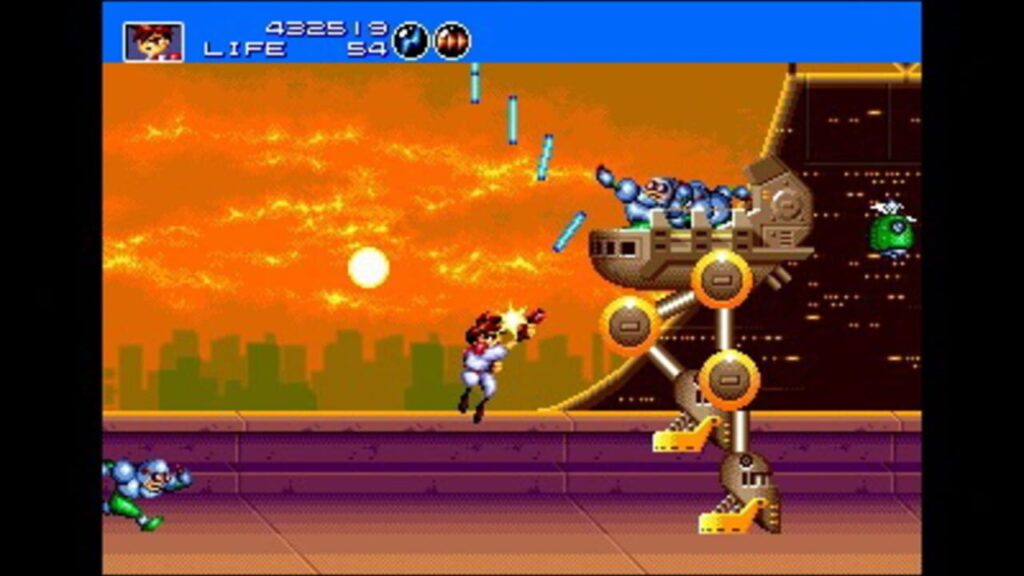
If you played Gunstar Heroes, you know exactly which boss I’m talking about. If you didn’t, buckle up: Seven Force is a transforming robot that shifts through seven different forms, each with its own attack pattern, each more ridiculous than the last.
You fight a crab. Then a tiger. Then a flying weapon. Then it turns into a GUN and shoots at you. And just when you think you’ve seen everything, it morphs into something else entirely.
This was one boss. ONE. And it was legendary.
But that’s the thing about Gunstar Heroes—every boss felt like someone at Treasure said “what if we just went completely insane with this?” The dice palace boss. The aerial dogfight. The final gauntlet. Each one was a spectacle that pushed the Genesis harder than you thought possible.
It Looked Like Nothing Else on Genesis
Treasure was showing off, and they weren’t subtle about it.
Gunstar Heroes had more sprites on screen at once than most Genesis games attempted. Scaling effects. Rotation. Perspective shifts. Parallax scrolling layers stacked so deep you could get lost in them.
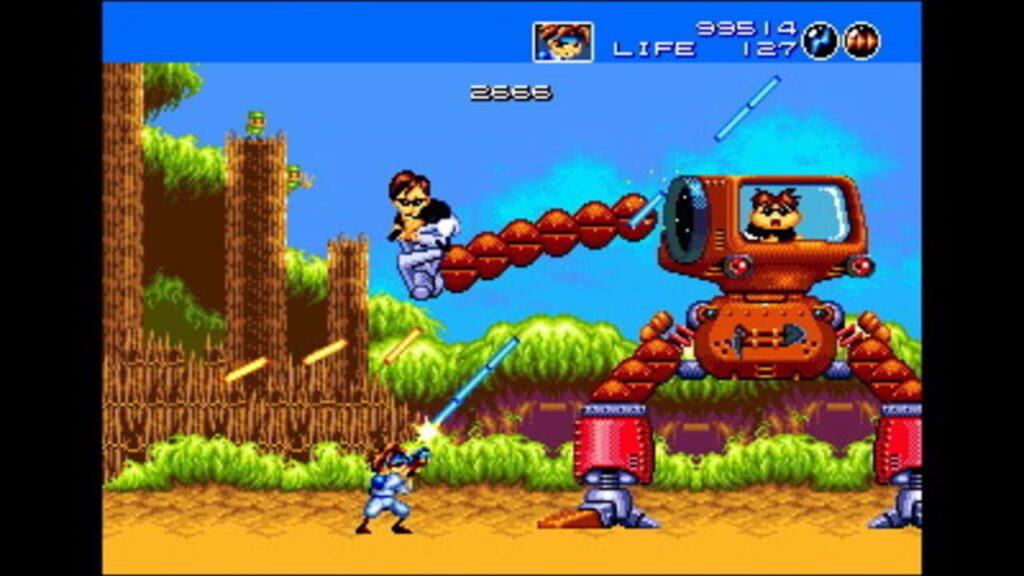
The Genesis wasn’t supposed to do some of this stuff. Treasure didn’t care.
That mine cart level? The one where the entire screen is rotating and scaling while you’re fighting bosses and the track is collapsing? That was Treasure saying “yeah, we can make the Genesis do this, actually.”
And the colors! While other Genesis games were fighting the console’s limitations, Gunstar Heroes embraced them and made everything pop. Bright, vibrant, kinetic. This wasn’t trying to look realistic—it was trying to look awesome. And it succeeded.
The Music Went Harder Than It Had Any Right To
Close your eyes and think about the Stage 1 theme.
You can hear it, right? That driving, urgent, absolutely relentless soundtrack that made you feel like you were in the middle of something important even though the plot was basically “bad guys are bad, shoot them.”
Composer Norio Hanzawa understood the assignment. Every track was designed to pump you up, keep you moving, make you feel unstoppable even when you were getting absolutely demolished by the dice boss for the seventeenth time.
The music didn’t just accompany the action—it was part of the action. When that boss music kicked in, you felt it. Your heart rate matched the tempo. You leaned forward on the couch. You were locked in.
Why Co-Op Made Everything Better
Here’s the truth: Gunstar Heroes is great solo.
But with a friend? It’s transcendent.
This was the era when “co-op” didn’t mean “play online with strangers.” It meant your best friend came over, you both sat on the floor three feet from the TV, and you experienced the game together.
Gunstar Heroes co-op was beautiful chaos. You’re both on screen, both shooting, both jumping, both dying, both laughing when something ridiculous happens (and something ridiculous was always happening).
You’d argue about weapon combinations. “No, YOU pick up the Lightning, I’ve got Chaser!” You’d accidentally shoot each other. You’d throw each other at enemies as an attack (yes, really). You’d celebrate when you finally beat that one boss that had been destroying you for an hour.
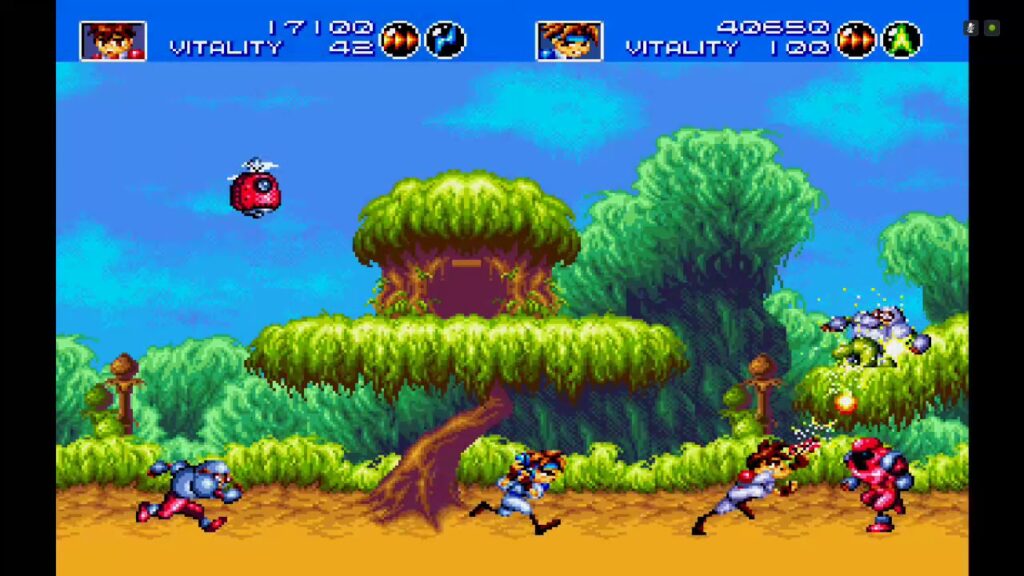
These weren’t just gaming sessions. They were events. Memories you’d bring up years later: “Remember when we finally beat Black’s Dice Maze?” “Dude, Seven Force.” “That mine cart level was INSANE.”
That’s what Gunstar Heroes gave you: stories you’d tell for decades.
The Stuff Nobody Talks About (But Should)
The Melee System Was Secretly Brilliant
Most run-and-gun games are about keeping distance and shooting. Gunstar Heroes said “what if you could also just punch, slide-tackle, and throw dudes?”
The melee combat was fast. You could slide into enemies, grab them, and chuck them at other enemies. You could do flying kicks. You could juggle enemies in the air with your gun.
It gave you options. When you were overwhelmed, you didn’t just backpedal and shoot—you fought. You got in close. You mixed gunplay with pure brawling in a way that made every encounter feel dynamic.
The Stage Select Let You Control Your Own Difficulty Curve
After the tutorial, the game didn’t force you down a linear path. You could choose which stage to tackle next (except the final one, obviously).
This was subtle genius. Having trouble with the dice stage? Try the flying stage first, get a power-up, come back stronger. Want to challenge yourself? Hit the hardest stage first.
It gave you agency without breaking the game’s structure. You were still playing through everything—you just got to decide the order. That kind of trust in the player felt rare, even then.
The Two Character Types Actually Mattered
Free Shot vs. Fixed Shot wasn’t just flavor text.
Free Shot let you move and shoot in different directions (the “correct” choice for most people). Fixed Shot locked your shooting direction but made you more mobile.
Most players picked Free Shot and never looked back. But the fact that the option existed—the fact that Treasure built two completely different control schemes into the same game—showed how committed they were to giving players choices.
What Made It Feel Different
You know what Gunstar Heroes didn’t have?
Grinding. Fetch quests. Tutorials that treated you like you’d never held a controller. Cutscenes that dragged on for minutes. Arbitrary difficulty spikes designed to pad runtime.
It had respect for your time.
Every second of Gunstar Heroes was about having fun. The levels were tight. The bosses were spectacular. The weapons felt great. The co-op was seamless. Nothing was there to waste your Saturday afternoon—everything was there to make it legendary.
This was peak “games as pure fun” design. Before open worlds and grinding for loot and season passes and battle passes and all the other stuff that makes modern gaming feel like a second job sometimes.
Gunstar Heroes was: here’s a gun. Here’s your buddy. Here’s an army of bad guys. Go.
The Legacy (Or: Why We’re Still Talking About This)
Gunstar Heroes didn’t sell millions of copies. It wasn’t a household name like Sonic or Street Fighter.
But it became a legend among people who knew.
You’d see it on “best Genesis games” lists. You’d hear people mention it in forums with reverence. Indie developers would cite it as an influence. “If you like Contra, try Gunstar Heroes” became gospel.
Treasure went on to make other incredible games (Radiant Silvergun, Ikaruga, Bangai-O), but Gunstar Heroes was their statement of intent. Their debut. The game that announced “we’re here, we’re talented, and we’re about to change what you think the Genesis can do.”
And they delivered.
Playing It Today
Here’s the beautiful thing: Gunstar Heroes still rips.
The graphics hold up because they were never trying to be realistic—they were trying to be expressive. The gameplay holds up because pure fun doesn’t age. The music holds up because good composition is timeless.
You can play it on:
- Sega Genesis Classics (available everywhere)
- Original hardware (if you’ve got it)
- Quality emulation (works perfectly)
- Various compilations over the years
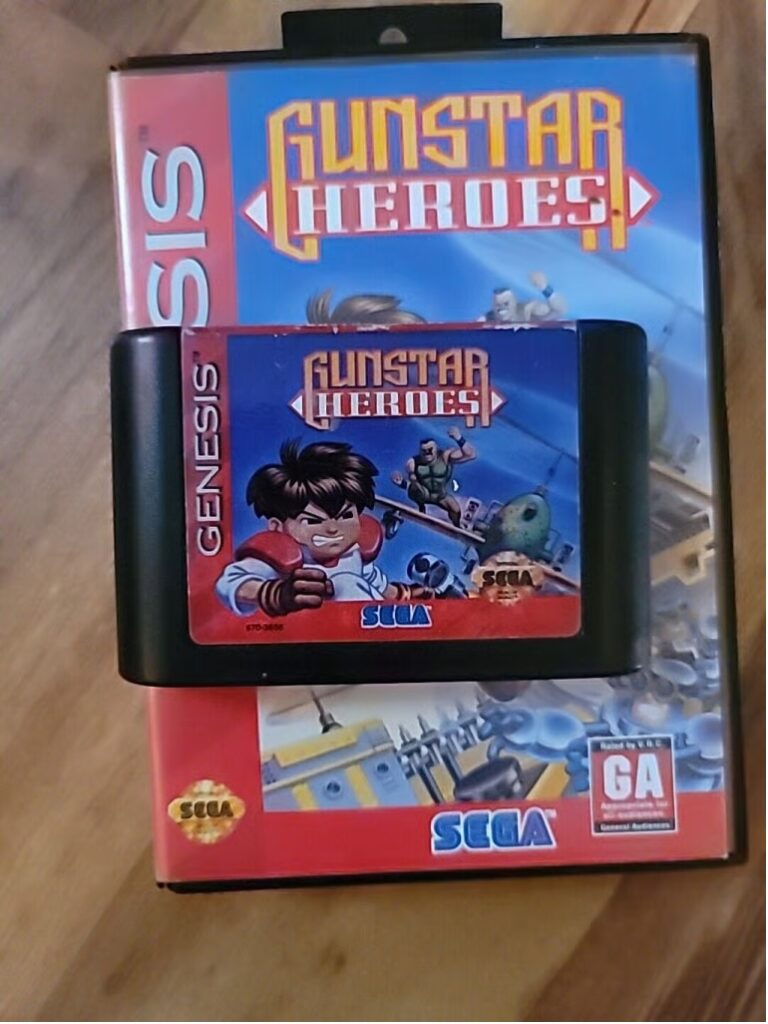
Grab it. Find a friend. Play it co-op. You’ll understand within ten minutes why people won’t shut up about this game.
Who Should Play This in 2025?
You’ll love it if:
- You want pure, concentrated fun with zero filler
- You appreciate games that respect your time and intelligence
- You like co-op that actually feels cooperative
- You want to see the Genesis pushed to its absolute limits
- You need something to play with a friend that isn’t a fighting game or sports title
Maybe skip if:
- You need deep narrative and character development
- You want slow-paced, methodical gameplay
- You prefer single-player experiences
- You need modern quality-of-life features
Why It Still Matters
Gunstar Heroes represents something we don’t see enough anymore: confidence.
Confidence that players are smart enough to figure out complex systems without hand-holding. Confidence that “fun” is a good enough reason for a game to exist. Confidence that pushing hardware limits will create something memorable.
It’s a game that knew exactly what it was and delivered it without apology or compromise.
No padding. No filler. No pretense.
Just you, your weapons, your buddy, and an army of enemies that never stood a chance.
Final Verdict: If you’ve never played Gunstar Heroes, you owe it to yourself to fix that. If you have played it, maybe it’s time to revisit it. Either way, grab a friend, load it up, and remember when games could make you grin like an idiot within the first thirty seconds.
The explosions are waiting.
What’s your favorite Gunstar Heroes moment? The mine cart? Seven Force? That insane final gauntlet? Hit reply and tell me—I want to hear your war stories.