
Posted on September 30, 2026
Batman: Arkham Asylum Review — Trapped in Gotham’s Madhouse, and Loving Every Minute
Disclosure: Some of the links in this post are affiliate links. As an Amazon Associate we earn from qualifying purchases. This means if you click on the link and purchase an item, we will receive an affiliate commission at no extra cost to you. All opinions remain our own. We only recommend products or services we believe will add value to our readers.
Seventeen years later, Rocksteady’s trip into Gotham’s madhouse remains one of the most atmospheric nights Batman ever spent in a video game.
There is a moment early in Batman: Arkham Asylum when you realize the game understands something that Batman games had spent years struggling to capture.
It isn’t the cape.
Or the gadgets.
Not even Batman flattening a room full of Joker’s goons.
It is the feeling of walking into a place where something is terribly wrong.
Arkham is dark, wet, claustrophobic and strangely alive. Guards mutter nervously. Inmates scream from behind locked doors. Joker’s voice crackles over the asylum speakers. Somewhere beyond the walls, thunder rolls over Gotham. And Batman — calm, controlled and almost absurdly prepared — keeps walking deeper inside.
Back in 2009, that atmosphere felt like a revelation.
Licensed superhero games had certainly produced good experiences before, but Arkham Asylum felt different. It did not merely give you a Batman-shaped character and send you through an action game. Rocksteady built the entire experience around the fantasy of being Batman: fighting like him, stalking criminals like him, investigating crime scenes like him and occasionally scaring the living daylights out of men who thought they were hunting you.
Nearly two decades later, that remains its greatest trick.
At a Glance

Platform: PlayStation 3, Xbox 360, Windows PC; later remastered for PlayStation 4 and Xbox One and released on Nintendo Switch
Released: August 2009
Developer: Rocksteady Studios
Publisher: Eidos Interactive / Warner Bros. Interactive Entertainment
Genre: Third-person action-adventure / stealth
Vibe: One long stormy night trapped inside the creepiest corner of Gotham City
You’ll Love It If: You enjoy Batman, stealth-action games, environmental exploration, Metroid-style progression and games with a strong sense of place
Maybe Skip If: You mainly want an enormous open-world Gotham or find repeated stealth arenas and collectible hunting tedious
Best Way to Play: The inexpensive PC GOTY release or Batman: Return to Arkham on modern PlayStation and Xbox hardware
Collector Note: Original PS3 and Xbox 360 copies are generally far easier to justify as nostalgic shelf pieces than expensive collector investments
Before Arkham, Batman Games Were Always Searching for Batman

One reason Arkham Asylum landed so hard in 2009 is that Batman already had decades of video games behind him. Some were genuinely enjoyable, others were fascinating experiments, and a few were the sort of licensed games that survived largely because kids loved the character printed on the box. Anyone who remembers Batman on the NES, Genesis, SNES or PlayStation knows how wildly different those interpretations could be.
One game emphasized platforming. Another became a side-scrolling brawler. Another put Batman behind the wheel. Others simply adapted whatever movie happened to be occupying theaters at the time. There was never a shortage of Batman games.
The problem was figuring out what a Batman game was supposed to be.
Arkham Asylum Felt Like a Place You Weren’t Supposed to Be
Plenty of games have larger worlds than Arkham Asylum.
Very few make such good use of a relatively small one.
The game begins with Batman escorting the Joker into Arkham following what seems like a suspiciously easy capture. Anyone who knows Joker knows immediately that the situation smells wrong.
It does not take long.
Joker escapes, Arkham falls into chaos, and Batman finds himself trapped on the island while villains, inmates and armed thugs gradually seize control.

From there, the asylum becomes almost a character itself.
You move through the Intensive Treatment building, the penitentiary, medical facilities, botanical gardens, caves and crumbling institutional corridors. Areas change as the night progresses. Enemies occupy spaces that were previously safe. New equipment opens passages you noticed hours earlier but could not reach.
That interconnected structure is one reason returning to Arkham Asylum can feel surprisingly different from returning to Arkham City or Arkham Knight.
Those sequels became bigger.
Asylum became tighter.
It feels like a haunted house built specifically for Batman.
Gameplay: The Part Your Hands Remember
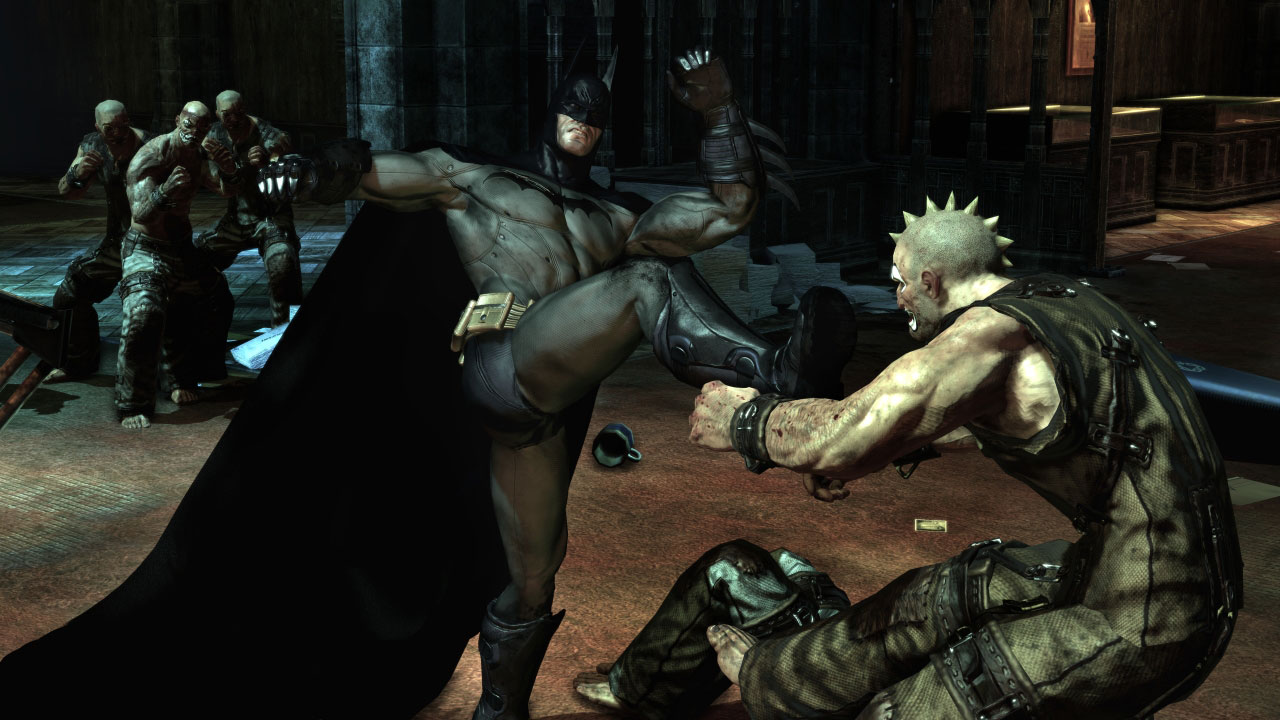
The combat is probably what many players remember first. Attack, counter, stun, evade—then keep the rhythm going.
Rocksteady called it FreeFlow combat, and in 2009 it made Batman look dramatically more capable without demanding fighting-game levels of button memorization. He slides between opponents, redirects attacks, breaks arms, knocks weapons away and moves across a room with an almost cinematic flow. The basic controls are easy to grasp, but maintaining a long combo means reading the room, anticipating threats and knowing when to break your rhythm before an enemy does it for you.
What makes the system work is that Batman rarely feels invincible.
He feels prepared.
Against a handful of ordinary thugs, he can dominate the room. Put firearms in those same hands, though, and charging straight in suddenly becomes a very bad idea. The game forces you to think differently, and that is where Arkham Asylum changes gears.
Becoming the Thing in the Rafters
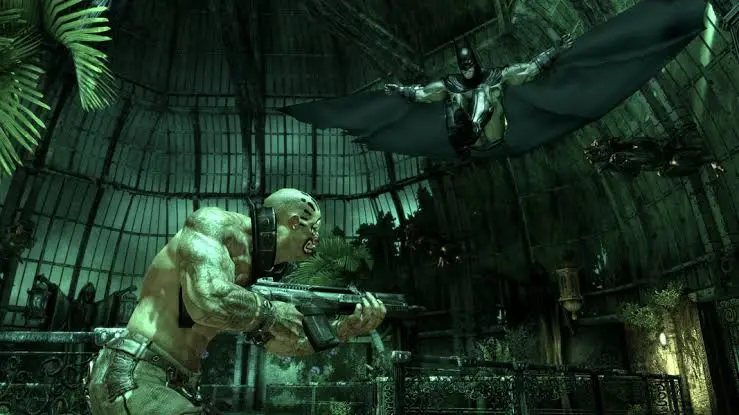
The game’s Predator encounters may be its most distinctly Batman mechanic.
A group of armed criminals occupies a room, and Batman enters somewhere above them. From there, the space slowly becomes his. You grapple onto gargoyles, crawl through vents, hang enemies upside down, silently grab isolated guards and disappear before anyone understands what happened.
Best of all, the enemies react. Take out enough of them and they become frightened, checking corners and firing nervously into shadows while Joker mocks them over the PA system. One thug discovers that his partner has vanished. Another realizes he is suddenly alone. Their confidence gradually collapses.
The enemies are afraid of you.
Stealth games had certainly existed long before Arkham Asylum, but Rocksteady used stealth to express something central to the Batman fantasy: fear as a weapon.
Detective Mode, Gadgets and the Joy of Looking Around

Then there is Detective Mode.
Tap it on and the world becomes an x-ray-like tactical overlay. Enemies appear through walls. Important objects become visible. Evidence can be analyzed. Structural weaknesses stand out.
Today, you can see one unintended consequence of its usefulness: Detective Mode is sometimes so practical that players may spend too much time looking at Arkham through a blue filter instead of admiring the environments.
But in 2009, it helped sell another part of Batman that games rarely emphasized properly.
He is a detective.
The actual investigations are not exactly Sherlock Holmes simulators. Batman usually identifies clues and the game leads you toward their solution.
Still, following a trail of fingerprints or tracking evidence makes the adventure feel different from simply following an objective marker.

The gadgets reinforce that feeling.
Batarangs.
Explosive gel.
The Batclaw.
Cryptographic tools.
Line launchers.
Each is useful in combat or exploration, and several open previously inaccessible paths through the asylum.
That gradual unlocking creates an almost Metroid-like pleasure: spotting a suspicious wall early in the game, remembering it hours later, returning with the right gadget and discovering something hidden behind it.
Riddler Made Sure You Never Stopped Looking

And then there was the Riddler.
Long before enormous open-world collectible maps became exhausting, Arkham Asylum encouraged players to scrutinize its relatively compact environment for trophies, riddles, hidden objects and environmental references. Some are straightforward collectibles, while others ask you to notice details in the world itself.
That distinction matters because so much of the fun comes from realizing how much Batman history Rocksteady packed into Arkham without stopping the story to announce every reference. Cells, patient interview tapes, villain biographies, environmental clues and names tucked into obscure corners all contribute to the sense that comic-book history is sitting just beneath the surface.
For Batman fans in 2009, that created a wonderful feeling: Rocksteady clearly knew the material, and it trusted players to recognize some of it too.
You were rewarded for paying attention.
Scarecrow Reminded Everyone That Games Could Still Mess With You

Certain moments in Arkham Asylum became memorable almost immediately, but the Scarecrow sequences occupy their own category. Saying too much about them spoils part of the fun for anyone somehow reaching the game fresh, but Rocksteady uses Scarecrow’s fear toxin as an excuse to temporarily break its own rules.
Reality bends, the interface becomes untrustworthy, and the game starts toying with expectations the player had already learned to trust. Batman moves through surreal spaces dominated by enormous visions of Scarecrow, and what had been an action-stealth adventure suddenly starts drifting toward psychological horror.
That is why these sequences stand out even now. They are not simply boss encounters built around a different mechanic. They are tricks played directly on the player.
And one particular trick probably convinced more than a few people in 2009 that something had gone horribly wrong with their console.
If you know, you know.
The Voices Sound Like Batman Because, For a Generation, They Were Batman

Much of Arkham Asylum’s atmosphere depends on its performances. Kevin Conroy returned as Batman, Mark Hamill as the Joker, and Arleen Sorkin as Harley Quinn, giving the game an immediate connection to Batman: The Animated Series for anyone who grew up with those voices.
Rocksteady did not simply recreate the cartoon, though. This Batman is bulkier, Arkham is nastier, the violence is harder, and the overall aesthetic leans much further into Gothic horror. Character designs exaggerate muscles, scars and grotesque proportions in a way that feels unmistakably late-2000s.
Conroy and Hamill are what keep it grounded.
Conroy’s controlled performance gives Batman weight without making him sound theatrical, while Hamill’s Joker fills the asylum with manic energy through monitors, loudspeakers and radio transmissions. You spend much of the game physically separated from him, yet his presence keeps bleeding into nearly every corner of Arkham.
You almost never escape him.
2009 Was an Incredible Year to Drop This Game
It is worth remembering what surrounded Arkham Asylum.
The Xbox 360 and PlayStation 3 generation was hitting its stride. Uncharted 2, Assassin’s Creed II, Modern Warfare 2, Dragon Age: Origins and Left 4 Dead 2 all arrived in 2009.
Big-budget games were increasingly cinematic, mechanically sophisticated and comfortable blending genres.
Then Rocksteady — a studio whose previous release had been Urban Chaos: Riot Response — arrived with a licensed superhero game that stood comfortably among the year’s major releases.
The reaction was not merely nostalgic revisionism.
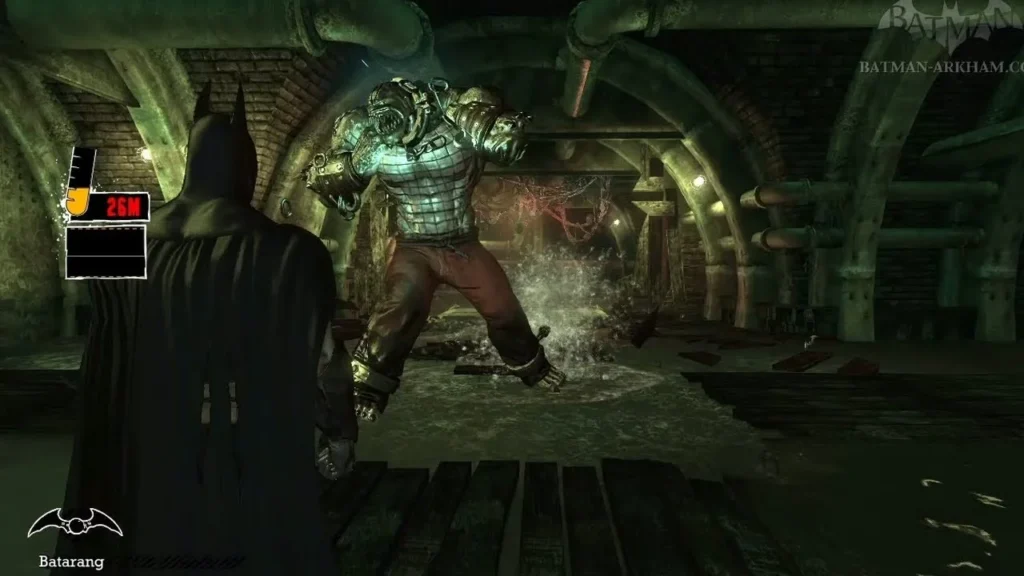
Contemporary reviews were exceptionally strong. The Xbox 360 version currently retains a 92 Metascore from 78 critic reviews, while the PlayStation 3 and PC releases also scored above 90. The reception was strong enough that Guinness recognized it at the time as the “Most Critically Acclaimed Superhero Game Ever.”
That mattered because licensed games still carried baggage.
You approached many movie and superhero games hoping they would be good.
Arkham Asylum became a game people recommended even if you already knew the license.
That was the breakthrough.
Where Arkham Asylum Shows Its Age
Revisiting Arkham Asylum today means noticing a few seams, and the boss fights are probably the most obvious. Several encounters lean heavily on variations of the oversized Titan enemies, while the final confrontation never quite matches the creativity of the game’s best sequences.
That imbalance produces one of the game’s strangest truths: stalking six nervous men through a hospital room can be more exciting than fighting one of Batman’s most famous villains.
Detective Mode has aged in a different way. It remains incredibly useful, but that usefulness can work against the art direction by encouraging players to spend too much time viewing Arkham through a blue tactical filter instead of taking in the environments Rocksteady worked so hard to build.

The combat also feels leaner in hindsight. FreeFlow remains readable and satisfying, but anyone coming backward from Arkham City or Arkham Knight will immediately notice how much smaller Batman’s original move set was.
That is less a flaw than a reminder that this was the foundation.
Returning to Arkham Asylum after playing its sequels is a little like going back to a band’s first great album after hearing everything that came later. The ideas are already there. The sequels simply had more room to expand them.
Why Arkham Asylum Still Matters
The influence of Arkham Asylum extends well beyond Batman. You can see echoes of its rhythm-based melee combat, counter indicators and group encounters in plenty of third-person action games that followed, but reducing its legacy to “the combat system other games copied” undersells what Rocksteady actually accomplished.
The more important breakthrough was how completely the game built itself around the character. A superhero game did not have to squeeze Batman into an existing genre template. The mechanics themselves could express who he was.
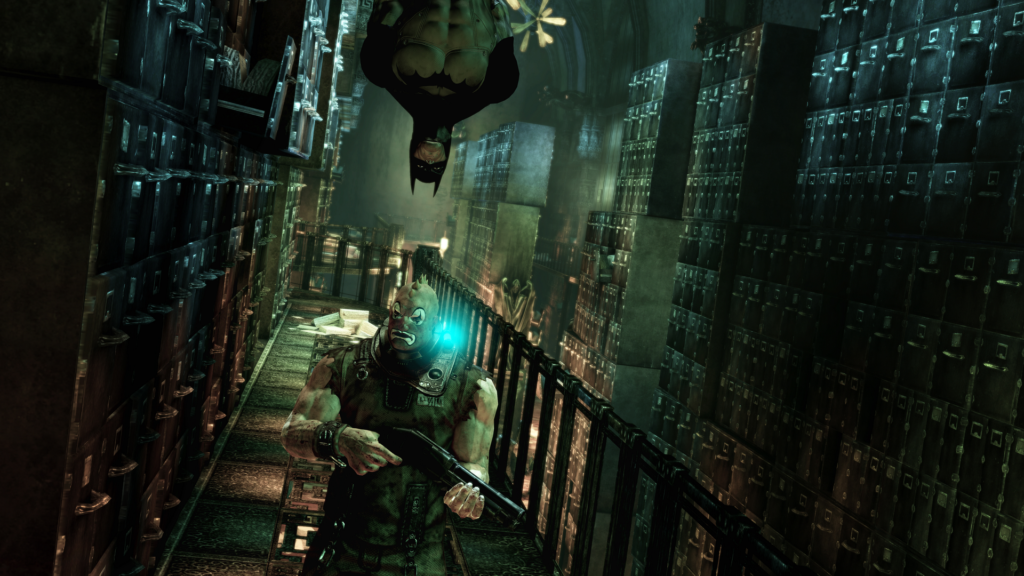
Combat reflected his martial skill. Predator rooms turned fear into a weapon. Detective Mode reinforced the investigative side of the character, while gadgets emphasized preparation and exploration rewarded curiosity. Even Arkham itself contributed to the fantasy by surrounding Batman with the darker mythology of Gotham.
That is why the game feels so cohesive.
Its systems are not simply entertaining on their own. They all point back toward the same character.
How Arkham Asylum Feels in 2026
Coming back to Arkham Asylum now, the surprising thing is not that certain mechanics have aged. Of course they have. Seventeen years is a long time in game design.
What feels unexpectedly refreshing is the game’s scale.
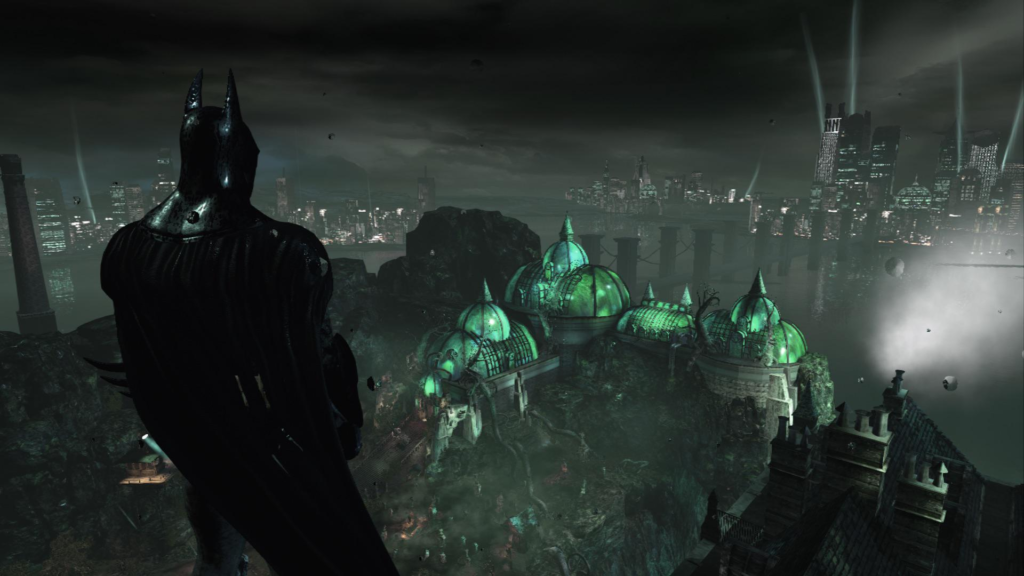
There are no enormous districts packed with icons, no vehicle sections, no sprawling city and no endless stream of side activities competing for your attention. Instead, the game gives you one terrible place, one terrible night and one Batman trying to bring the whole thing back under control.
Arkham gradually unfolds around you, opening new routes and revealing more of itself as the night progresses. That restraint gives the game a personality its larger sequels cannot quite replicate.
A younger player discovering the series today may initially wonder why traversal feels limited compared with Arkham City or why the world feels so contained.
Give it time.
The claustrophobia is part of the point.
Best Way to Play Batman: Arkham Asylum Today
You have several sensible options in 2026.
The Batman: Arkham Asylum Game of the Year Edition remains available on Steam, where it was listed at $19.99 when checked for this review. It includes additional Challenge Maps and is currently Steam Deck Verified.



On PlayStation and Xbox, Batman: Return to Arkham bundles remastered versions of Arkham Asylum and Arkham City. The PlayStation Store currently lists the collection for PS4 and notes that it is playable on PS5 through backward compatibility, while Xbox lists it for Xbox One and Xbox Series X|S.


Nintendo players can get Arkham Asylum as part of the Batman: Arkham Trilogy on Switch. Warner Bros. Games released that compilation in December 2023 with Arkham Asylum, Arkham City, Arkham Knight and their previously released DLC. On the physical Switch edition, Arkham Asylum is actually included on the cartridge, while City and Knight require downloads.
Collectors who specifically want the 2009 experience can still hunt down the Xbox 360 or PlayStation 3 releases. But unless original hardware, packaging or shelf nostalgia matters to you, there is little reason to make an original disc your only route into the game.
The Night Batman Finally Became Batman
There is something wonderfully uncomplicated about returning to Arkham.
Not simple.
Uncomplicated.
Rocksteady gives you a dark building full of criminals, hidden passages, frightened guards, strange secrets and some of Batman’s most dangerous enemies.
Then it gives you the cape.
The rest practically writes itself.
That is why Batman: Arkham Asylum remains such an easy game to remember.
It preserves a particular moment when superhero games stopped feeling like adaptations we hoped would be good and began demonstrating what could happen when developers treated the character himself as the game-design document.
New players should absolutely expect a few 2009 rough edges. The boss fights rarely equal the Predator encounters. Detective Mode is too useful for its own good. Later Arkham games greatly expand Batman’s abilities.
None of that takes away the night’s essential magic.
Turn off the lights.
Put on headphones.
Walk through Arkham’s gates.
Listen to Joker laughing somewhere over the intercom.
Then watch the first armed thug realize he is no longer hunting Batman.
Batman is hunting him.
That feeling is the memory Arkham Asylum preserves.
And seventeen years later, it is still a very good reason to go back.