
Posted on September 24, 2026
How to Start Collecting for the PlayStation 1: A Beginner’s Guide
Disclosure: Some of the links in this post are affiliate links. As an Amazon Associate we earn from qualifying purchases. This means if you click on the link and purchase an item, we will receive an affiliate commission at no extra cost to you. All opinions remain our own. We only recommend products or services we believe will add value to our readers.
Build your first PS1 collection without overpaying, buying the wrong hardware, or wasting money on games you will not actually enjoy.
There is something wonderfully dangerous about deciding to start PS1 collecting.
Maybe you remember that gray console sitting beneath a bulky CRT, the strange electronic orchestra of the startup screen, and the ritual of flipping through jewel cases trying to decide whether tonight belonged to Tekken 3, Final Fantasy VII, Gran Turismo or something you rented because the cover looked cool.
Or maybe you missed the PlayStation era completely and want to understand why that little gray box became one of the most important consoles ever made.
Either way, the temptation is the same: open eBay, start searching, and suddenly convince yourself that you need pristine black-label copies, a boxed launch console and twelve games before you have even played the first one.
You don’t.
The smartest way to begin collecting PlayStation 1 games is much simpler: buy reliable hardware, get the accessories you actually need, choose a handful of affordable games you genuinely want to play, and let the collection grow naturally.
That approach is cheaper, more enjoyable and much less likely to leave you staring at an expensive shelf wondering when your hobby became inventory management.
Who This Guide Is For

This guide is primarily for the beginner collector, returning retro gamer and nostalgia-driven player who wants to own real PS1 hardware and physical games without turning the experience into a financial endurance test.
It is also useful if you already play PlayStation games through emulation or modern hardware but want to begin owning some of the original objects.
Because there is an important distinction here:
Playing PlayStation games and collecting PlayStation games are related hobbies, but they are not exactly the same hobby.
You can enjoy one without going all-in on the other.
Quick Picks: The Easiest Way to Start PS1 Collecting
Best Overall Beginner Console: A tested later-model original PlayStation — the classic experience without specifically chasing the earliest hardware.
Best Compact Option: PSone — smaller, attractive and fully capable of providing the original PS1 experience.
Best Budget Strategy: Buy tested loose hardware and common games rather than complete-in-box collector pieces.
Best Controller: An original Sony DualShock or standard PlayStation controller in tested condition.
Best Memory Card: A tested official Sony card.
Best First Games: Affordable classics from several genres rather than expensive collector favorites.
Best Modern Convenience Option: A PS3 you already own can play PlayStation-format discs, though Sony notes that compatibility is not absolutely perfect in every case.
Skip If: A seller cannot demonstrate that the console reads games reliably, or a listing’s biggest selling point is simply that something is supposedly “RARE.”
How We Are Judging What Is Worth Buying

For beginners, collector prestige should not be the first criterion.
I would rank condition, reliability, price, compatibility and actual enjoyment ahead of rarity or completeness. Nostalgia matters—we are retro gamers, after all—but nostalgia becomes considerably less charming when a thirty-year-old disc drive refuses to load the game you just bought.
The questions I would ask before almost every early purchase are simple:
Will I play this?
Is it tested?
Is the condition acceptable for what I am paying?
Am I paying for the game—or for the packaging around the game?
Could I buy something more enjoyable with the same money?
Those five questions will prevent a surprising number of bad purchases.
Which PlayStation 1 Console Should You Buy?
For most beginners, I would buy a tested later-model full-size PlayStation or a PSone rather than specifically hunting for the earliest SCPH-1001 model.
There is nothing inherently wrong with wanting an early machine. In fact, early PlayStations have interesting hardware characteristics that enthusiasts appreciate. But the SCPH-1001 generation is also associated with aging optical-drive problems. iFixit specifically notes that earlier PlayStation optical drives can suffer from warped plastic rails, while ConsoleMods documents skipping problems associated with early CD-drive assemblies.
That makes the earliest machine more interesting to hardware enthusiasts than necessary for someone who simply wants to begin collecting.
At the time of writing in September 2026, PriceCharting places the loose market value of a standard PlayStation system at around $60, based on completed sales, while recent tested bundles have sold in roughly the same general territory. A loose PSone is tracking around $69. Condition, included controllers, cables, model revision and seller reputation can move those numbers considerably.

Do not interpret those figures as prices you must pay. Treat them as a sanity check.
If someone wants $150 for an ordinary unboxed PS1 because it is “vintage,” keep scrolling.
What Should You Ask a Seller?
“Tested” should mean more than “power light comes on.”
Ideally, you want confirmation that the machine:
- powers on consistently
- outputs video and audio
- reads game discs
- plays beyond the opening screen
- recognizes controllers
- recognizes memory cards
- opens and closes properly
- does not constantly skip during audio or full-motion video
A video showing the actual unit loading a game is even better.
Cosmetic yellowing, scratches and missing stickers may matter to collectors, but they generally matter far less than a failing optical drive.
Do You Need the Original Controller?
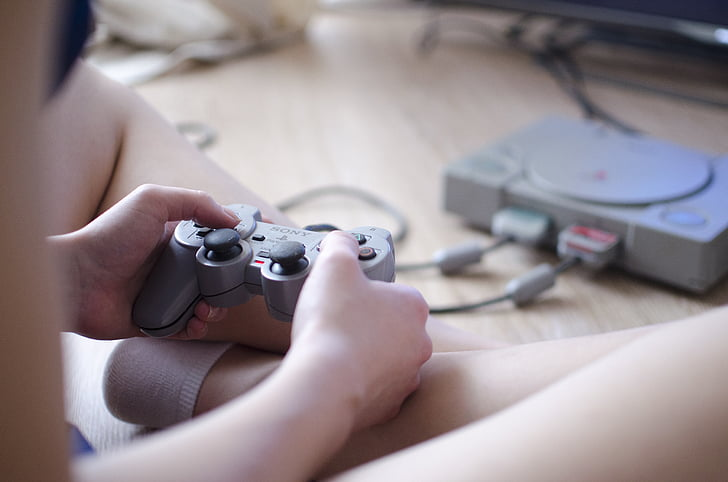
You do not technically need an original controller to begin playing, but this is one area where I think authentic hardware is worth buying.
The PlayStation controller is part of the experience.
An original Sony pad currently tracks around the mid-teens loose, while standard DualShock controllers can also be found around that general neighborhood depending on condition and color.
That is not a huge premium for something you will physically interact with every minute you play.
If you’re buying online, pay particular attention to the cable, analog sticks, shoulder buttons and signs of heavy wear. “Works” and “feels good” are not always the same thing.
Buy a Memory Card Earlier Than You Think
This sounds painfully obvious until you are twenty minutes into an RPG and remember that your beautiful 1990s console has absolutely nowhere to save anything.
An original Sony PS1 memory card is one of the first accessories I would buy. PriceCharting currently tracks a standard loose card at around $14, although individual completed sales vary.
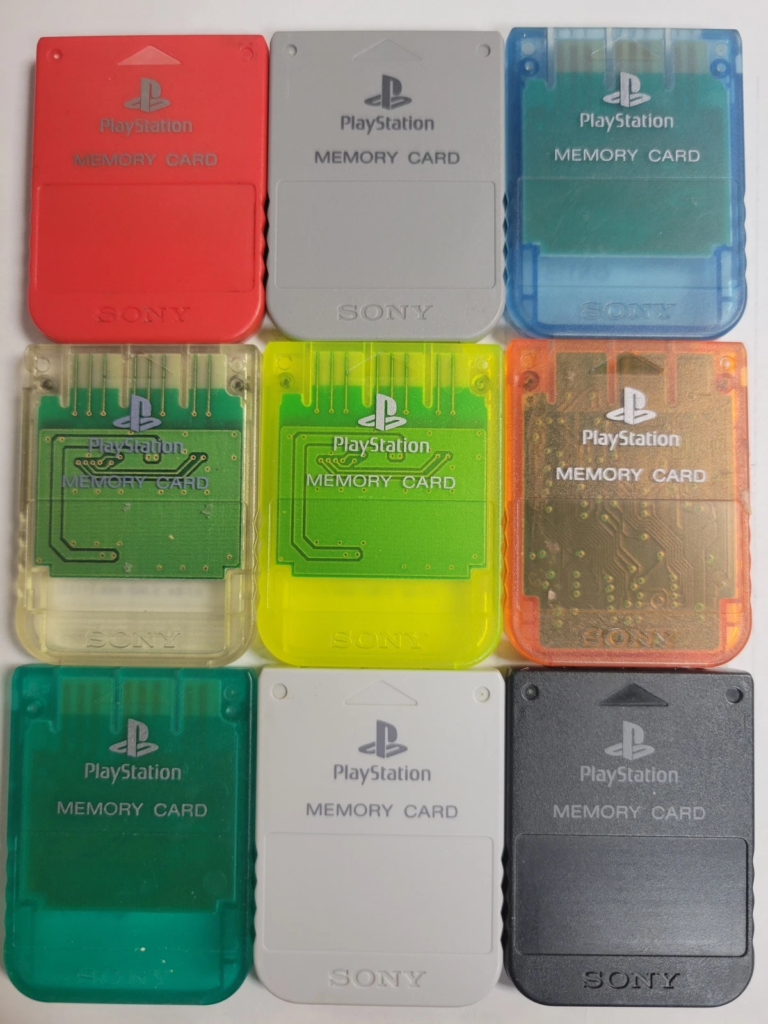
At that price level, I would rather begin with a tested Sony card than gamble on the cheapest mystery memory card available.
And eventually, buy another one.
The PS1 era produced plenty of games that can occupy large portions of a card, and juggling save files is authentic nostalgia in roughly the same way that rewinding VHS tapes is authentic nostalgia: charming right up until you actually have to do it.
Build Your First Library Around Games, Not Rarity
Here is where PS1 collecting can become expensive very quickly.
The PlayStation library contains enormously desirable RPGs, survival horror games, cult releases and low-print titles. Some now cost more than the console they run on.
Ignore them for a while.
Seriously.
One of the great advantages of collecting for a successful mass-market console is that millions of copies of many excellent games were produced. That means you can build an enjoyable starter library without immediately entering the high-end collector market.
Current market data illustrates the point. Loose copies of Gran Turismo 2, Tekken 3, Crash Bandicoot: Warped and Spyro the Dragon are still generally tracking in relatively affordable territory, with several sitting around the $9–$15 range at the time of writing.

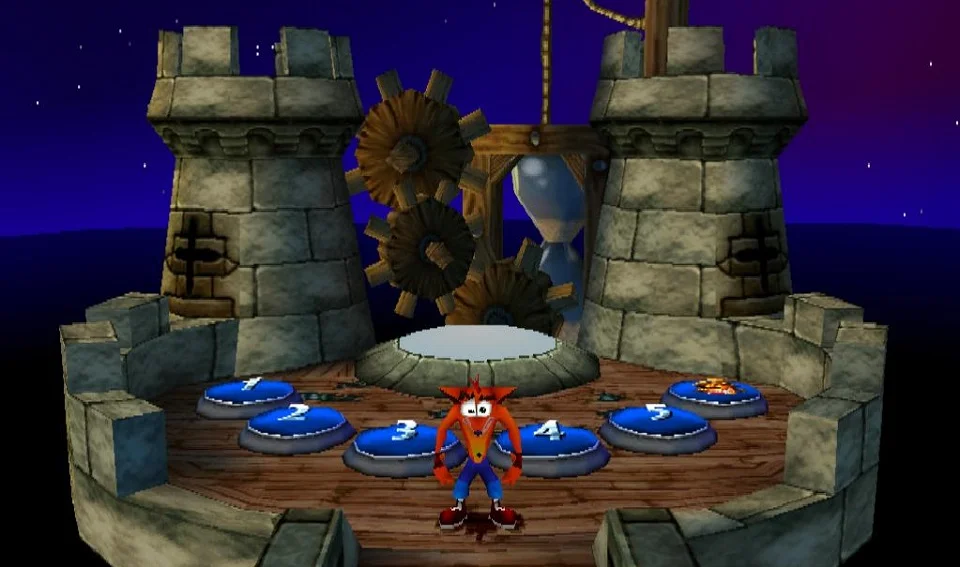


That gives you racing, fighting and platforming without sacrificing the grocery budget.
My ideal first collection would cover several genres:
Racing: Gran Turismo 2
Fighting: Tekken 3
Platforming: Crash Bandicoot: Warped or Spyro the Dragon
RPG: A reasonably priced Final Fantasy release such as a Greatest Hits copy of Final Fantasy VII, if current pricing makes sense
Wildcard: One game you personally remember, always wanted, or simply think looks fascinating
That last category matters more than people admit.
Your collection should eventually become a map of your own taste—not somebody else’s list of “essential” games.
Black Label vs. Greatest Hits: Don’t Let the Green Stripe Bully You

Ah yes, the green label.
Some collectors strongly prefer original black-label PlayStation releases over Greatest Hits versions. If uniform shelf presentation matters to you, that preference is perfectly legitimate.
But if you are primarily interested in playing games?
Buy the cheaper legitimate copy.
A Greatest Hits edition does not make Tekken 3 punch any less hard.
This is one of the first places where beginner collectors accidentally spend money on someone else’s priorities. If two authentic copies contain the same game and one costs significantly less because collectors prefer the other label, the cheaper copy may be the smarter player’s purchase.
You can always upgrade later.
Loose, Complete or Complete-in-Box?
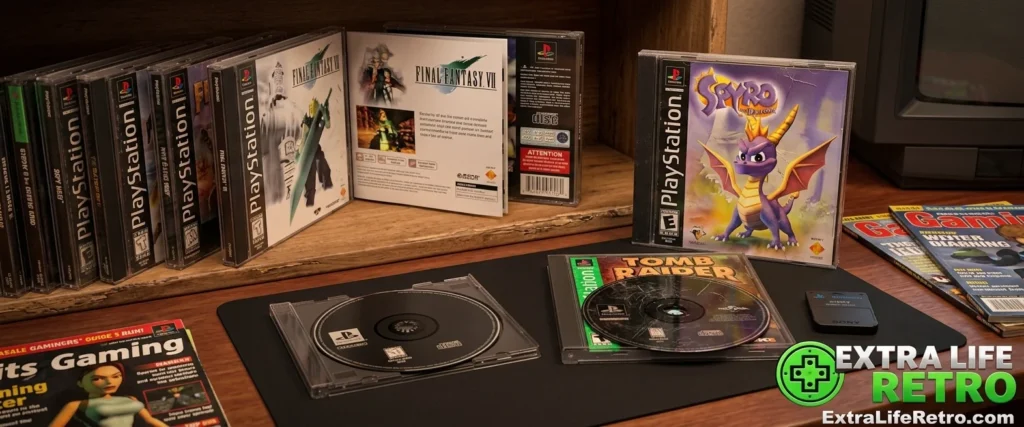
For disc-based games, “loose” generally means the disc without the complete original packaging, while complete copies usually include the case, back artwork and manual appropriate to the release.
My preferred beginner sweet spot is complete but not pristine.
PS1 jewel cases are part of the era’s identity. There is something satisfying about seeing that artwork lined up on a shelf and opening a case to find the manual still inside. But ordinary jewel cases can crack, and obsessing over flawless plastic is rarely worth paying a huge premium.
Condition should also influence your priorities.
A clean disc inside a replacement jewel case is much more useful to a player than a gorgeous original case containing a disc that resembles an ice-skating rink.
Collectors may feel differently—and that is fine.
Your First $100–$200 PS1 Collection
This is where the hobby becomes much less intimidating.
Using current market references rather than wishful thinking, a practical starter budget can genuinely land somewhere around this range.
A rough allocation could look like this:
Tested PS1 console: around $60–$70
Original controller: roughly $10–$20
Official memory card: roughly $10–$15
Four to six affordable games: perhaps $40–$80 depending on titles and completeness

That puts a functional original-hardware collection somewhere around $120–$185 before shipping, using current-market ballparks rather than assuming miraculous garage-sale finds. Prices can move quickly, and bundled systems may shift the math in either direction.
More importantly, that gives you an actual collection.
Not one expensive game.
A collection.
What to Avoid Before You Spend Too Much
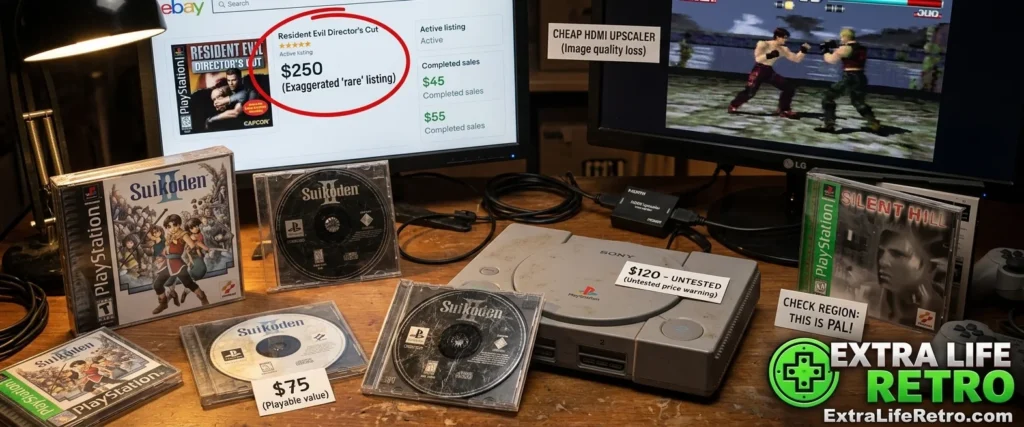
Untested Consoles at Tested Prices
“Untested” frequently means exactly that, but it transfers the risk to you.
Unless you enjoy repairing hardware, price an untested machine as a project—not as a working console.
Badly Scratched Discs
PS1 discs have survived rental stores, dorm rooms, younger siblings, glove compartments and things polite society should probably never discuss.
Light surface wear is one thing. Deep scratches are another.
Ask for clear underside photos when buying expensive games.
Paying Huge Premiums for CIB Copies Immediately
Complete packaging is wonderful if collecting original objects is your goal.
It is unnecessary if your primary goal is playing.
Do not spend your entire starter budget turning one $15 game into a $70 shelf decoration unless completeness genuinely matters to you.
“Rare” Listings Without Evidence
Marketplace sellers discovered the word “rare” approximately five minutes after online marketplaces were invented.
Check completed sales, not adjectives.
PriceCharting is useful because its market estimates are derived from completed transactions rather than simply asking prices.
Buying Imported Games Without Checking Region Compatibility
Standard retail PlayStation consoles are region locked. Japanese, North American and PAL software belong to different software regions, so an imported disc should not be assumed to run on an ordinary North American machine.
Import collecting can be fantastic.
Just know what hardware you are buying it for.
Cheap Video Converters Because They Say “HDMI”
Connecting an original PS1 to a modern television is where the hobby gets slightly less plug-and-play.
The PS1 was designed for analog displays, not today’s HDMI-only televisions. Quality scaling solutions exist, including equipment built specifically to work with retro signals, but they can cost considerably more than a generic converter.
Do not assume that a $12 box with “1080P!” printed on it produces the same result as equipment designed around retro-game video signals.
For beginners, I would get the console and games sorted first, then decide how deeply you want to go into video hardware.
Original Hardware or Modern Convenience?

There are really three different PS1 experiences.
Best for Players
Buy games because you want to play them. Choose Greatest Hits copies when they save money, accept replacement jewel cases, and do not obsess over cosmetic perfection.
If you already own compatible modern hardware or use legitimate digital re-releases, there is also nothing wrong with playing a game digitally before deciding whether it deserves space in your physical collection.
Best for Collectors
Condition, original artwork, manuals, variants and completeness matter more here.
This is where black-label releases, long-box editions, regional variants and pristine copies begin making sense—but only once you understand what you are collecting and why.
Full Nostalgia Option
Original PS1.
Original Sony controller.
Original memory card.
Physical game.
CRT television.
A Saturday afternoon with nowhere particularly important to be.
This is not the most convenient option.
That is precisely the point.
Where Should You Buy PS1 Games?
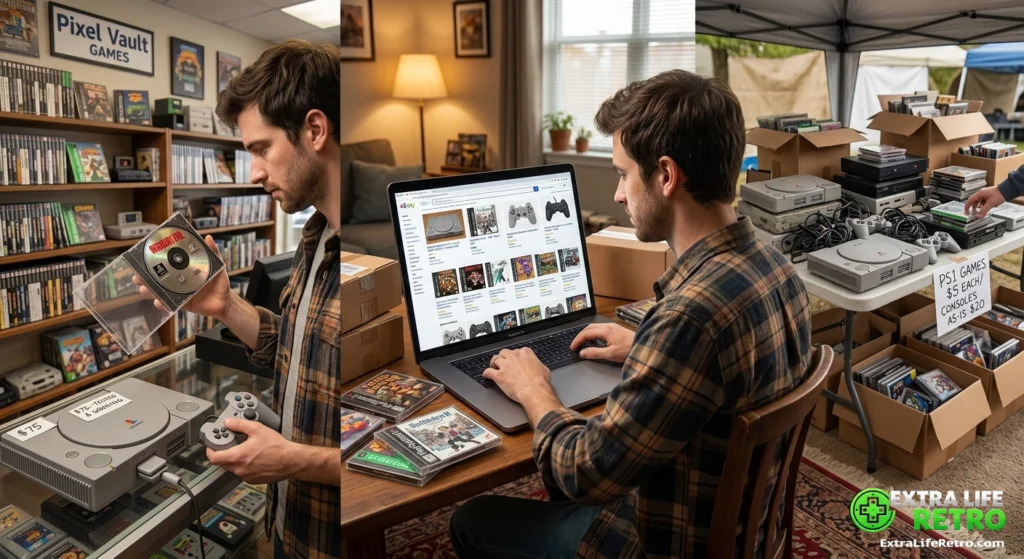
For sheer selection, eBay remains difficult to beat for original PlayStation hardware and games, especially once you begin searching for specific releases or variants.
Local retro stores have one huge advantage, however: you can inspect what you are buying. You may pay slightly more, but being able to examine a disc, controller or console before money changes hands can be worth the difference.
Facebook Marketplace, flea markets and estate sales can produce deals, but they require considerably more buyer judgment.
And regardless of marketplace, comparison shop.
A listing price is not a market price.
My Recommendation: Start Small and Let the Collection Tell You What Comes Next
If I were beginning a PlayStation 1 collection today, I would buy a tested later-model console or PSone, one original Sony controller, one genuine memory card and about five games.
Then I would stop shopping.
Play them.
That sounds almost revolutionary in a collecting culture that constantly shows us walls containing hundreds of games, but playing your first handful teaches you what kind of collection you actually want.
Maybe you rediscover a love for survival horror.
Maybe you decide Namco fighters are your thing.
Maybe JRPGs swallow the next three years of your life.
Maybe you become fascinated with weird experimental games that could only have escaped into retail during the glorious creative chaos of the late 1990s.
Let that experience shape the shelf.
The best PS1 collection is not necessarily the biggest, rarest or most valuable one. It is the collection where pulling a case from the shelf makes you want to turn the console on.
Thirty years later, that little gray machine can still do that remarkably well.
And really, isn’t that why we’re collecting this stuff in the first place?