
Posted on August 5, 2026
The Adventures of Batman & Robin SNES: Gotham’s 16 Bit Masterpiece
Disclosure: Some of the links in this post are affiliate links. As an Amazon Associate we earn from qualifying purchases. This means if you click on the link and purchase an item, we will receive an affiliate commission at no extra cost to you. All opinions remain our own. We only recommend products or services we believe will add value to our readers.
Konami did not merely put Batman: The Animated Series on a cartridge. It built an eight-episode journey through the Gotham we remembered from television.
The opening moments tell you almost everything. A dark Gotham skyline. Police lights flashing against brick walls. Batman standing beneath the moon while that familiar animated-series atmosphere settles over the screen. Before you have thrown a single Batarang, The Adventures of Batman & Robin already feels different from the average licensed game that crowded store shelves during the 16-bit era.
This was the kind of cartridge that could stop a kid in the rental aisle. The artwork promised the same shadowy Gotham, sharp silhouettes, impossible machinery, and theatrical villains that made Batman: The Animated Series feel more sophisticated than anything else airing after school. Then you brought it home, pushed the cartridge into the Super Nintendo, and discovered that Konami had taken that promise unusually seriously.
Released in 1994, the SNES version was not a simple brawler or a hurried collection of familiar characters. It was an episodic action-platformer filled with gadgets, puzzles, villain-specific ideas, strange experiments, and some wonderfully dramatic 16-bit scenery. It could be slow, difficult, and occasionally frustrating, but it understood something many licensed games missed: playing Batman should involve more than punching whichever criminal happens to walk in from the right side of the screen.
At a Glance
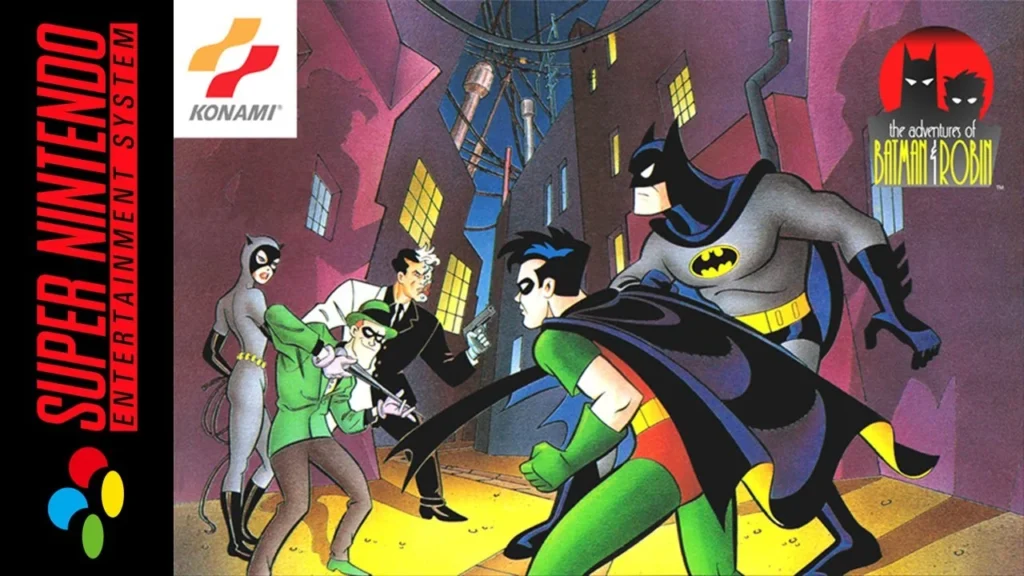
Platform: Super Nintendo
Released: 1994 in Europe; December 1994 in North America
Developer: Konami
Publisher: Konami
Genre: 2D action-platformer
Vibe: A playable Saturday-night tour through the art-deco shadows, carnival nightmares, rooftop chases, and colorful rogues’ gallery of Batman: The Animated Series.
You’ll Love It If: You enjoy atmospheric 16-bit action games, classic Batman, deliberate platforming, useful gadgets, and levels that constantly change their ideas.
Maybe Skip If: You want fast arcade combat, forgiving checkpoints, cooperative play, or the ability to play as Robin.
Best Way to Play: An original cartridge on a Super Nintendo or compatible hardware remains the only straightforward official option, although the cartridge has become expensive.
Collector Note: This is no longer an inexpensive nostalgia pickup. Loose cartridges regularly command three-figure prices, while boxed copies can cost substantially more.
The Batman Game That Understood the Cartoon
Licensed games were everywhere in the early 1990s. Some were good. Many were weekend rentals that looked more exciting on the box than they felt once the title screen disappeared.
The Adventures of Batman & Robin was different because it understood that the television series was not memorable simply because Batman fought famous villains. The show had a visual language: a legendary aesthetic known as Dark Deco. Developed by Bruce Timm and Eric Radomski, it blended 1930s Art Deco architecture with 1940s film noir shadows, retro-futuristic technology, and a revolutionary “painted-on-black-paper” technique that gave Gotham City an unmatched moody, timeless atmosphere, long shadows, red skies, towering architecture, old automobiles, enormous industrial machinery, and characters who moved like figures from an animated film noir.

Konami translated that identity with surprising care.
Each major stage is structured like an episode, complete with a title card and a featured villain. Rather than forcing every character into the same kind of side-scrolling level, the game builds its challenges around the personality of each adversary. Joker gets a deadly amusement park. Poison Ivy takes over a theater with monstrous plants. Penguin hides inside a museum filled with hostages and locked exhibits. Catwoman turns the rooftops into a chase. Riddler traps Batman inside puzzles and distorted spaces.
That structure gives the game a rhythm closer to a television marathon than a conventional platformer. You are not just moving through eight increasingly difficult obstacle courses. You are entering a new Gotham story every time the screen fades to black.
The SNES game was developed and published by Konami and released in North America in December 1994. It is a completely different production from the later Genesis, Game Gear, and Sega CD games bearing the same name.
Eight Episodes, One Very Busy Night in Gotham
The adventure begins with “Amused to Death,” a Joker story that immediately shows how much variety Konami intended to pack into the cartridge. Batman fights through Gotham’s streets before entering a funhouse filled with mechanical traps, distorted rooms, hostile toys, and platforms designed to make the player distrust almost everything on the screen.

The Joker stage is an ideal opening because it feels recognizable. You punch thugs, disarm gunmen with Batarangs, climb, jump, and use Batman’s grappling hook. Then the game keeps adding strange little twists until the whole level feels like one of Joker’s elaborate televised deathtraps.
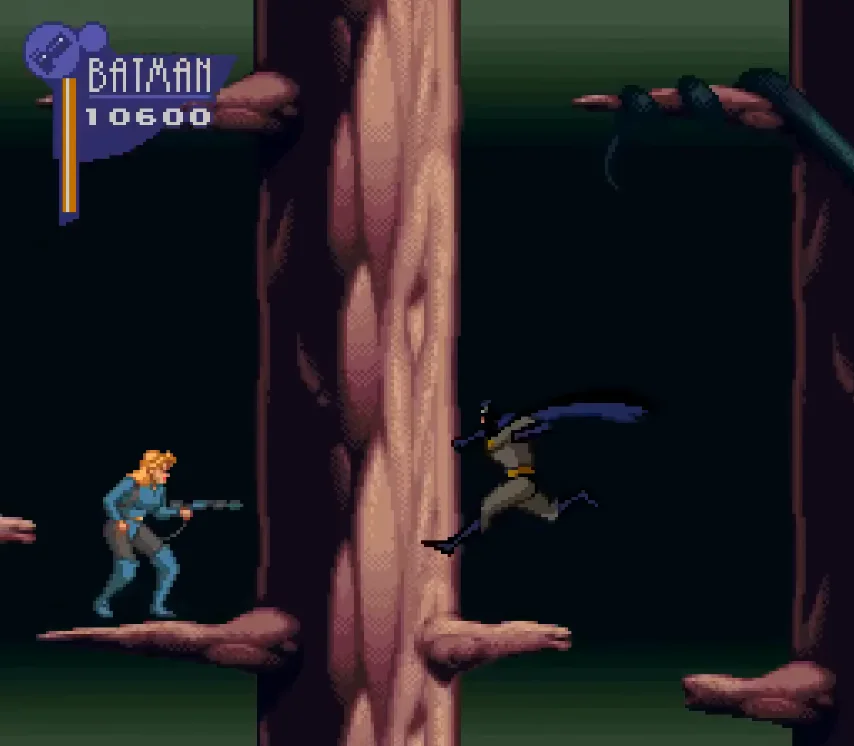
Poison Ivy’s “No Green Peace” episode shifts the emphasis toward platforming and environmental hazards. Batman must navigate plant-infested spaces where brute force is not always the solution. The level reinforces the idea that gadgets and positioning matter just as much as direct combat.

Penguin’s museum is one of the game’s most ambitious sections. Instead of running straight toward a boss, Batman searches multiple areas, rescues hostages, rides elevators, and works through a space that feels almost like a compact action-adventure dungeon. It is methodical, slightly confusing, and completely appropriate for a villain who surrounds himself with stolen treasures and armed henchmen.
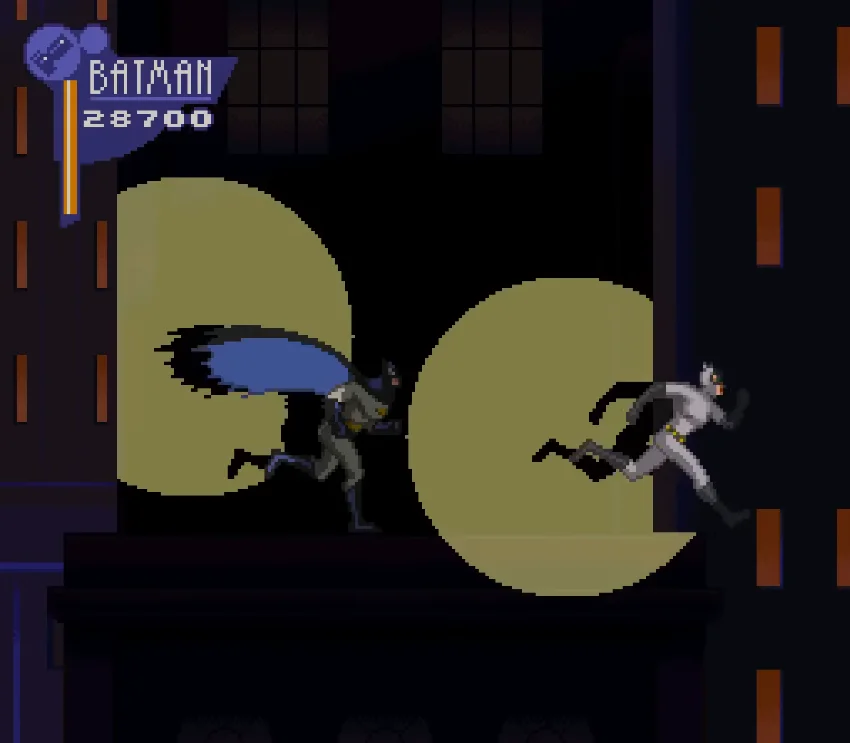
Catwoman’s rooftop chase provides one of the game’s strongest visual memories. Batman pursues her across Gotham while the city stretches behind them, turning a simple chase into a little piece of animated theater. Later stages bring Two-Face, Riddler, Scarecrow, and Penguin back into the picture, with driving sequences, maze-like environments, hallucinations, and bosses that rarely settle for standing still and trading blows.
This constant reinvention has divided some players over the years. One level might emphasize combat, another traversal, another exploration, and another a gimmick that barely resembles what came before it. That can make the campaign feel uneven, but it also prevents the game from becoming another licensed brawler built around repeating the same punch combination for two hours. Contemporary and retrospective reviews have consistently noted both the game’s impressive variety and its occasional lack of focus.
Gameplay: The Part Your Hands Remember
Batman moves with more intention than speed.
He can punch, kick, jump, crouch, block, roll, cling to certain surfaces, leap from walls, and fire his grappling hook toward overhead anchor points. He also carries Batarangs that can knock weapons from armed enemies before they fill the screen with gunfire. That little disarming move is one of the details that makes the game feel authentically Batman rather than like an ordinary platformer wearing a cape.
The grappling hook is even more important. It lets Batman climb vertically, swing across gaps, avoid hazards, and reach areas that initially appear inaccessible. Using it well requires timing because Batman does not automatically fly toward every ledge like a modern superhero character. You must watch the ceiling, understand the arc, and commit to the movement.
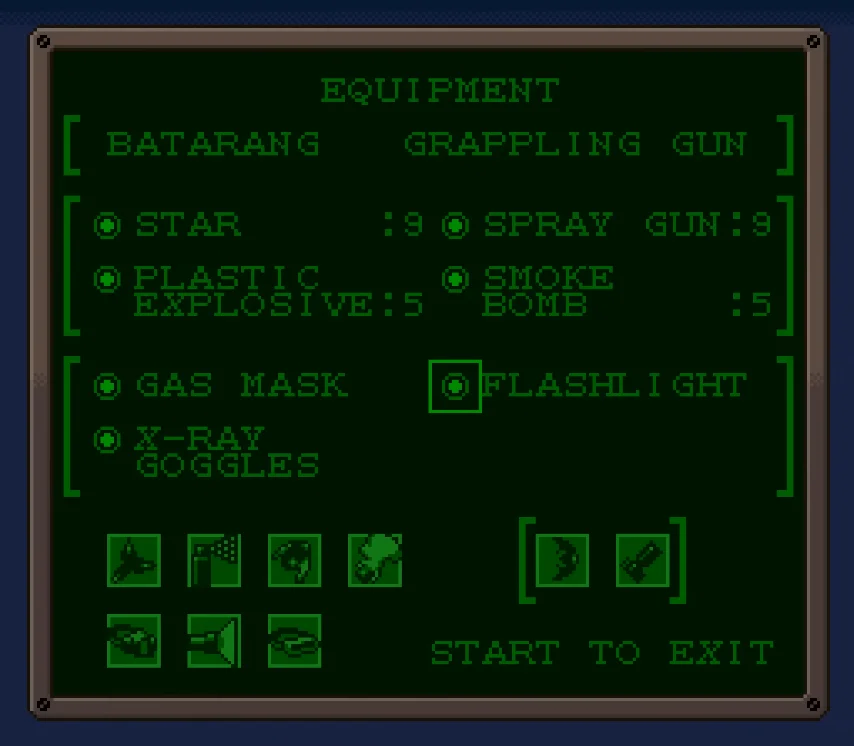
Batman can also select extra equipment before certain missions. Smoke bombs, throwing stars, gas masks, flashlights, and X-ray goggles appear when a particular situation demands them. Some gadgets are optional advantages; others are effectively answers to environmental problems. The result is a game that occasionally asks you to think like Batman rather than merely look like him.
The combat is deliberate. Batman is powerful, but he does not glide between enemies with the effortless rhythm of the later Arkham games. You need to consider distance, block incoming attacks, disarm armed opponents, and avoid being surrounded.

That slower pace can surprise new players. Batman has weight, and his animations sometimes continue just long enough for an enemy to interrupt your next move. Quick jumps and attacks do not always emerge as rapidly as your fingers expect. Next Generation specifically criticized Batman’s slow movement and the game’s uneven difficulty, complaints that remain understandable during a modern revisit.
Once the controls click, however, the movement begins to make sense. Rolling beneath danger, wall-jumping toward a higher platform, swinging from the grapple, and landing with Batman’s cape spread behind him gives the character a physical presence few superhero games of the era managed.
Learning Gotham the Hard Way
The basic controls are not complicated, but the game expects observation and repetition.
There are no glowing markers explaining where to grapple. No objective arrow tells you which museum room contains the next hostage. No checkpoint appears every few minutes to protect your progress. When a strange environmental puzzle arrives, the game assumes you will experiment, fail, and eventually understand what Konami wants.
That was normal enough in 1994. A difficult section could become a week-long project. You might rent the game on Friday, reach one confusing room on Saturday, and return it Sunday evening with the mystery unsolved. Maybe the answer appeared in a magazine. Maybe a friend knew the trick. Maybe you simply started over enough times to notice the one background detail you had been missing.

The game uses passwords, so progress does not have to disappear whenever the console is turned off. Still, those passwords belong to the era of handwritten codes, crossed-out characters, and the terrible realization that someone may have mistaken a zero for the letter O.
Several stages also punish impatience. Charging ahead can place Batman directly in gunfire or trigger a trap before you understand the room. The challenge is sometimes rewarding and sometimes unfair, but success usually comes from learning the game’s language rather than overpowering it.
Gotham Has Never Looked Better on the SNES
The visual presentation remains the game’s greatest strength.
Batman’s sprite is large, clearly animated, and faithful to the broad shoulders, square jaw, gray suit, and flowing cape of the television design. Enemies resemble characters who might have stepped out of an episode. Joker bends and gestures with theatrical energy. Catwoman moves with speed and personality. Backgrounds use deep blues, smoky purples, sickly greens, carnival reds, and heavy blacks to recreate the series’ stylized Gotham.
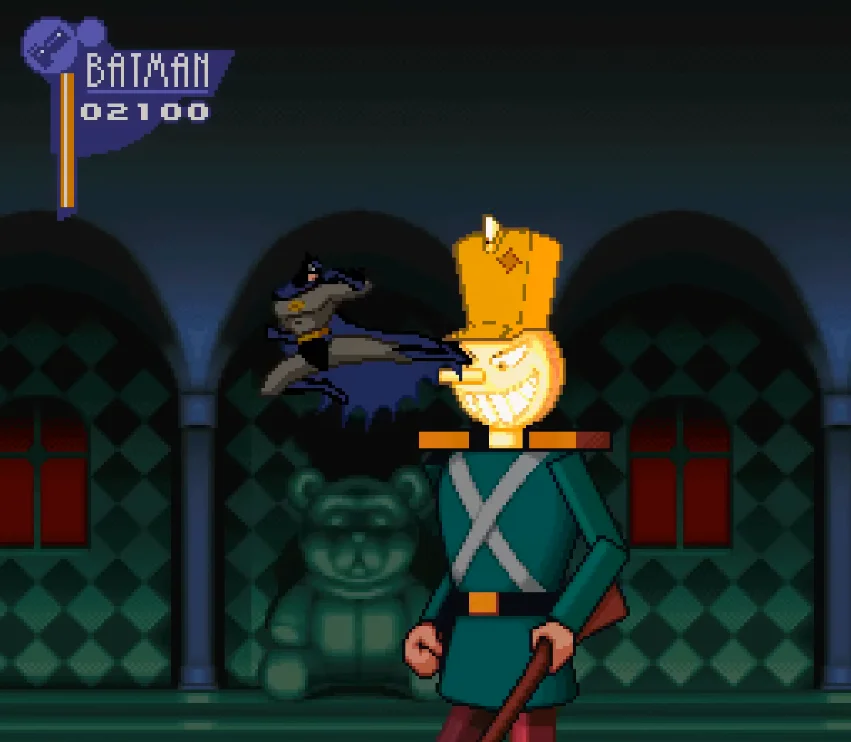
Konami also understood how important scale was to Batman’s world. Buildings loom over the streets. Museum displays dominate rooms. Machinery feels oversized and dangerous. Amusement-park attractions become moving hazards. The city rarely feels like a flat strip of platforms floating in front of decorative wallpaper.
The environments are packed with visual references to the animated series without becoming cluttered. The art-deco influence is especially strong, preserving the mixture of 1940s architecture and impossible retro-futuristic technology that made the cartoon’s Gotham so distinctive. Contemporary reviews praised the graphics and atmosphere, while later retrospectives have continued to single out the game’s fidelity to the show.

There are rougher moments. The Batmobile section is less attractive and less precise than the side-scrolling stages, and some large visual experiments are more impressive in concept than execution. Even so, the game has a unified art direction that remains more valuable than technical perfection.
Music from the Same Dark Corner of Gotham
The soundtrack does not merely provide energetic platforming music. It tries to preserve the dramatic character of the animated series.
The music moves between suspense, carnival unease, mystery, danger, and heroic momentum. Joker’s territory sounds playful in the wrong way. Darker stages use brooding melodies and low tones that make empty rooms feel threatening. Boss music creates the feeling that the villain has finally stepped into the spotlight for the episode’s closing act.
The sound effects add impact without overwhelming the atmosphere. Punches land with satisfying weight. Batarangs cut through the air. Machinery clanks. Enemies shout. The grappling hook fires with a sharp mechanical snap.
It is the kind of audio presentation that can bring the game back before you even see it. Hear a few seconds of that moody 16-bit Gotham music through a television speaker, and suddenly the room feels darker than it did a moment ago.
GamePro’s original review praised the sound and the game’s eerie atmosphere even while criticizing some of its dialogue and driving controls.
A Rogues’ Gallery Instead of One Long Story
The narrative is not presented as one elaborate continuous plot. Instead, the game borrows the episodic structure of the show, moving Batman from one villain-centered crisis to another.
That approach works because the rogues’ gallery is the story.
Joker’s amusement park tells you who he is through mechanical laughter and deadly spectacle. Poison Ivy transforms the environment into a weapon. Penguin hides behind wealth, collections, and hired muscle. Catwoman refuses to become a conventional villain waiting patiently at the end of a corridor. Scarecrow manipulates perception. Riddler turns architecture itself into a challenge.

The cartridge does not have the space to recreate the show’s deeper character writing, but it captures each villain through level design. The stages become compact personality studies built from platforms, hazards, colors, music, and boss mechanics.
Robin, unfortunately, gets the worst deal. Despite receiving equal billing in the title, he is not a playable partner. The game is strictly single-player, and Robin’s limited involvement disappointed reviewers even in the 1990s.
Anyone expecting couch co-op between the Dynamic Duo should know that the Genesis version—not this SNES game—is the version built around playable Batman and Robin action.
When Licensed Games Were a Gamble
Part of the game’s reputation comes from when it arrived.
By late 1994, the Super Nintendo library was crowded with polished platformers, fighting games, RPGs, arcade conversions, and licensed releases competing for attention. Donkey Kong Country was demonstrating new visual tricks. Super Metroid had expanded expectations for exploration and atmosphere. Players already knew Konami through games such as Contra III, Castlevania IV, Teenage Mutant Ninja Turtles IV, and Batman Returns.
That made the Konami logo reassuring. It did not guarantee greatness, but it suggested the license might receive more care than the average cartoon adaptation.
The timing also mattered because Batman: The Animated Series had built a genuine relationship with its audience. This was not merely a recognizable superhero stamped onto a cartridge. For many young players, this version of Batman was Batman. Kevin Conroy’s voice, the black title cards, Shirley Walker’s music, Bruce Timm’s designs, and the tragic interpretations of villains had become part of the decade’s shared pop-culture vocabulary.

A game that looked like the cartoon therefore carried enormous emotional weight. Even players who never finished it often remembered the first Joker level, the rooftop pursuit, the oversized sprites, or the realization that the game was far more complicated than a simple beat ’em up.
It also fit rental culture perfectly and cruelly. The recognizable box made it easy to choose. The difficulty made it difficult to conquer before Monday morning. Plenty of players probably saw the opening episodes repeatedly while the later stages remained mysterious territory described by friends or shown in magazine screenshots.
The Rough Edges Beneath the Cape
Despite the nostalgic induced affection in playing this game, you can’t deny that it does have real problems.
Batman can feel slow when the level demands immediate reactions. Some enemies attack from awkward positions, and armed thugs can drain health quickly when the player has not mastered disarming them. Platforming occasionally requires more precision than the controls comfortably provide.
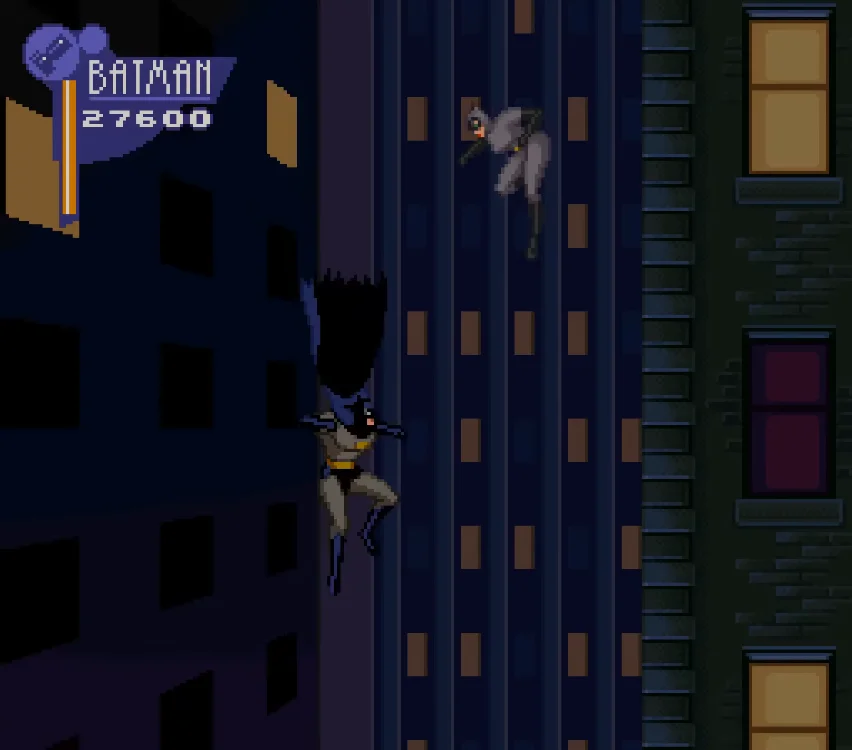
The difficulty is inconsistent. One section may feel manageable, followed by a stage that becomes a wall until you understand a specific item, route, or mechanic. Limited opportunities to recover health make long sequences more punishing, especially when experimenting with unfamiliar hazards.
The Batmobile material is the clearest weak spot. It adds variety and looks exciting in screenshots, but the handling and visual clarity do not match the confidence of the core platforming stages. Original reviewers also identified the driving portions as one of the game’s weaker elements.
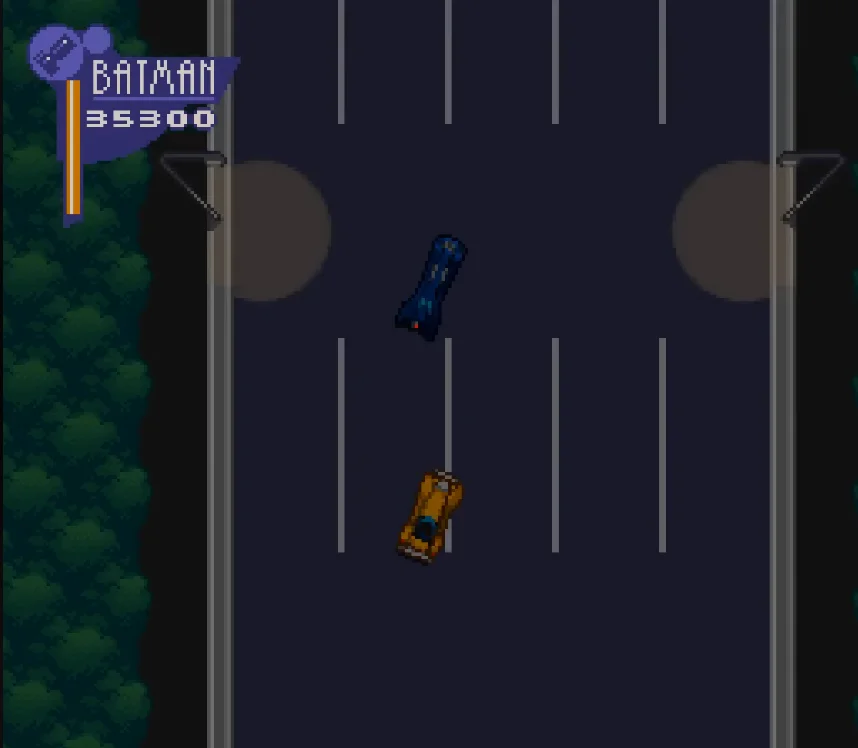
The campaign’s constant genre shifts can also feel unfocused. Players who love the opening action-platforming may not enjoy wandering through the museum. Someone who enjoys the exploration may resent being pushed into a driving sequence. The game keeps changing the rules, and not every experiment is equally successful.
Then there is Robin. His absence as a playable character is difficult to ignore in a game with both names on the box.

None of these flaws destroy the experience, but they do require patience. This is not a game to approach while distracted or expecting instant superhero empowerment. Gotham makes you earn the cape.
How It Feels to Revisit Today
The strongest parts still feel purposeful.
The art direction remains beautiful. The episodic structure gives every stage an identity. Gadgets distinguish Batman from ordinary action heroes. The game’s willingness to combine combat, platforming, exploration, puzzles, chases, and environmental storytelling still feels ambitious.
The roughness is equally visible. The pace is slower than many players will expect, and the controls demand deliberate inputs. Some objectives are not obvious. Losing progress after a difficult sequence can sting much more when modern games have trained us to expect generous checkpoints.

New players should begin on Normal rather than treating the hardest setting as a test of honor. Spend time learning the roll, block, wall jump, Batarang, and grappling hook before assuming Batman is simply unresponsive. When the game introduces a strange obstacle, consider whether one of Batman’s tools is the intended solution.
Save states can reduce repetition when using legally owned software through appropriate hardware, but relying on them after every jump can flatten the tension that gives the original design its personality. A good compromise is to create a save at the beginning of each major section and let the individual rooms play as intended.
Nostalgia certainly strengthens the experience, particularly for viewers who grew up with the animated series. But the game is not dependent on childhood memory. Younger players can still appreciate it as an unusually thoughtful licensed adaptation and a fascinating step toward the later idea of making the player feel like Batman.
Best Way to Play Today
There is no widely available official modern port or current subscription release of the SNES game as of August 2026. Nintendo’s current Super Nintendo Classics service offers many SNES titles, but this Batman game is not among the titles identified during this review’s availability research.
That leaves original hardware as the clearest official route.
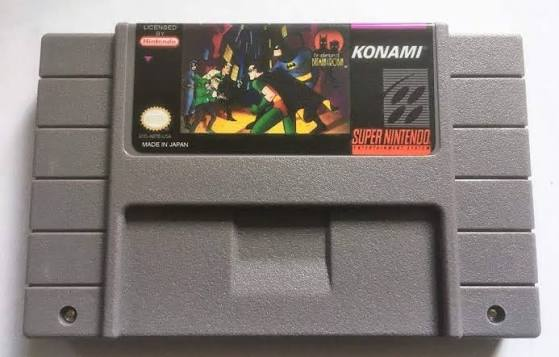
A loose original cartridge is best for dedicated SNES collectors who genuinely want the game on the shelf and plan to play it. The problem is price. Current PriceCharting data places a loose copy around the mid-$100 range, with complete copies valued far higher. Those figures fluctuate with condition and recent sales, but they are enough to make this an expensive purchase rather than a casual impulse buy.
Before paying collector prices:
- Confirm that the cartridge is authentic.
- Examine the label and shell for replacement parts.
- Ask for clear board photographs when buying from a private seller.
- Compare completed sales rather than relying only on active listings.
- Decide whether you truly need the box and manual, because complete copies carry a steep premium.
Players using an original SNES on a modern television may also benefit from a reputable HDMI solution or upscaler, particularly one designed to handle 240p signals correctly. A cheap generic converter can introduce lag and make Batman’s already deliberate movement feel worse.

A high-quality reproduction SNES-style controller or controller adapter may be useful when playing on compatible modern hardware, but it is not necessary for anyone whose original controller remains responsive.
Collectors will get the full nostalgia hit from the authentic cartridge. Casual players should be honest with themselves: this is an excellent game, but spending well over $100 solely to satisfy curiosity is difficult to recommend. A future licensed collection or digital rerelease would immediately become the more practical option.
Why This Gotham Still Matters
The Adventures of Batman & Robin matters because it treated a licensed cartoon game like an opportunity rather than an obligation.
Konami could have built eight corridors, filled them with identical thugs, placed a famous villain at the end of each one, and still sold cartridges to Batman fans. Instead, it tried to translate the personality of the series into game design. Joker’s madness became a funhouse. Riddler’s intelligence became puzzles. Catwoman’s independence became a chase. Batman’s preparation became a menu of specialized tools.
Not every idea works. The difficulty can be unforgiving. The Batmobile sections are awkward. Robin deserved much more than his supporting role. The cartridge is now expensive enough that many curious players will reasonably decide not to buy it.
Yet the game preserves a very particular retro memory: the moment when a television world seemed to continue after the episode ended. You switched off the cartoon, turned on the Super Nintendo, and Gotham was still there—dark, theatrical, dangerous, and waiting behind the title screen.
Longtime fans of Batman: The Animated Series should revisit it with patience. Collectors should buy carefully rather than chasing inflated listings. Newer players should approach it as a deliberate action-adventure game, not a primitive Arkham substitute.
It is remembered because it understood the assignment. It did not merely give us Batman’s costume, villains, and logo.
It gave us one more night in that Gotham.