Posted on July 15, 2026
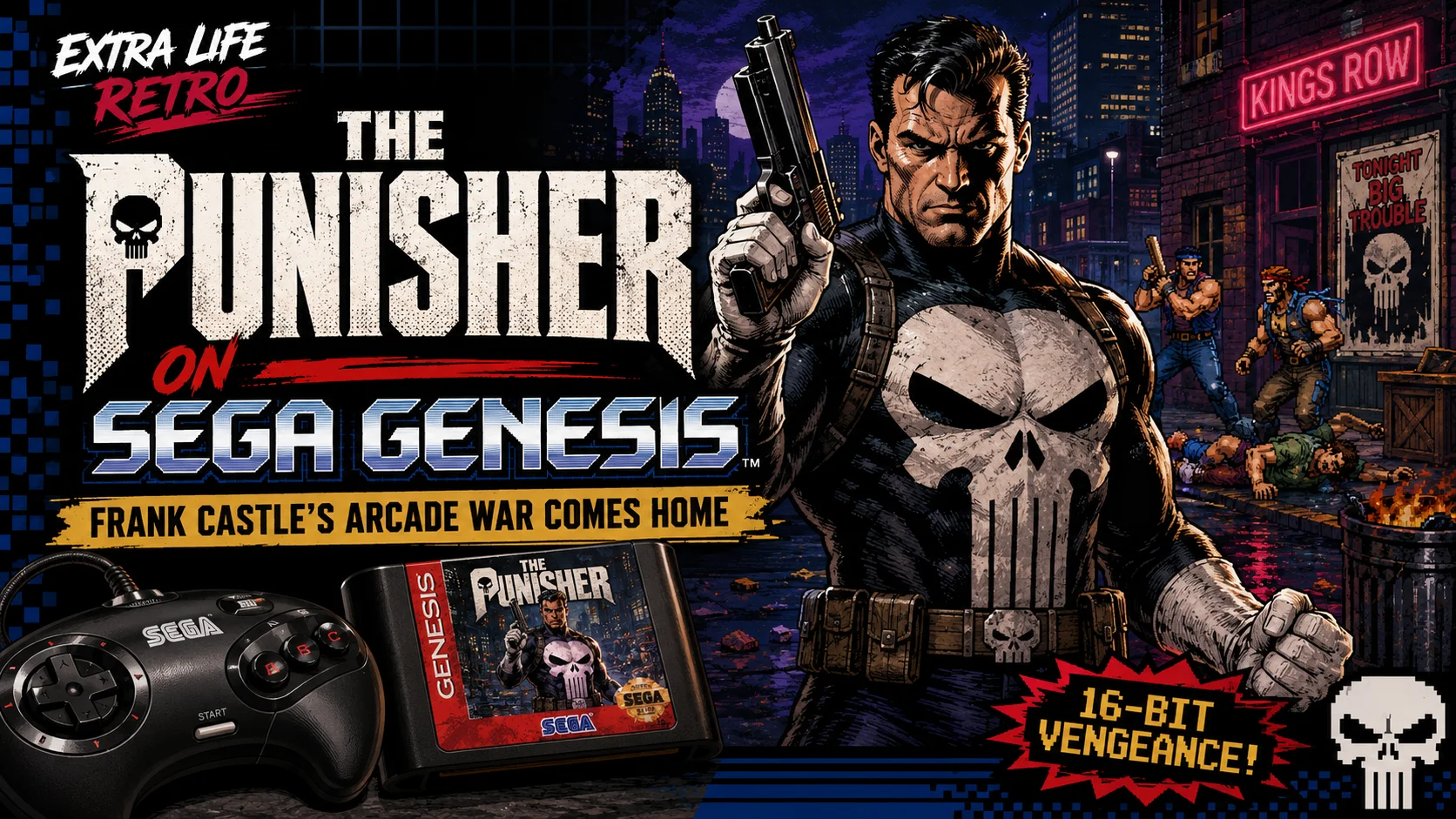
The Punisher Sega Genesis: Frank Castle’s Arcade War Comes Home
Disclosure: Some of the links in this post are affiliate links. This means if you click on the link and purchase an item, we will receive an affiliate commission at no extra cost to you. All opinions remain my own. We only recommend products or services we believe will add value to my readers.
Some video game characters need an elaborate story before the action can begin. Frank Castle only needs a room full of criminals and a reason to walk through the door. That brutal simplicity made The Punisher Sega Genesis port such a natural fit for the side-scrolling beat ’em up.
The 1993 arcade game took the familiar rhythm of moving right, clearing enemies and smashing everything in reach, then gave it the hard-edged personality of a Punisher comic. Guns appeared mid-fight. Furniture became weapons. Mob enforcers crowded the screen. Nick Fury joined the war as a second playable character. It was loud, violent and wonderfully excessive.
When the game reached the Sega Genesis in 1995, it arrived with an irresistible promise: Capcom’s arcade chaos, now playable from the living-room floor without feeding another quarter into a cabinet. The conversion could not carry every enemy, animation or explosive detail home with it, but it preserved enough of the experience to become one of the system’s most fascinating licensed brawlers.
Today, The Punisher Sega Genesis version occupies an unusual place. It is both an imperfect arcade port and an expensive collector’s piece. This review looks beyond the price tag to revisit what the game actually feels like, what was lost in translation and why Frank Castle’s 16-bit war remains so memorable.
At a Glance
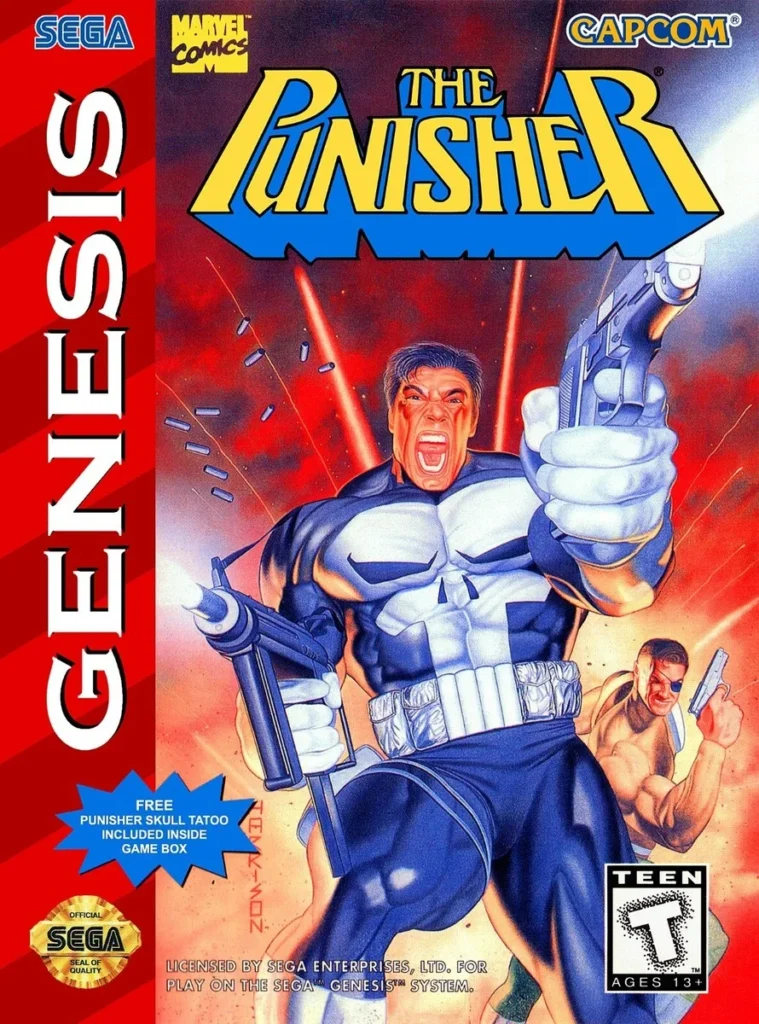
Platform: Sega Genesis
Released: February 1995 in North America; April 1995 in PAL regions
Developer: Sculptured Software
Publisher: Capcom
Genre: Side-scrolling beat ’em up
Vibe: A grimy comic-book street war packed with broken furniture, mob enforcers, automatic weapons, and Frank Castle’s permanently clenched fists.
You’ll Love It If: You enjoy Capcom-style arcade brawlers, Marvel games, couch co-op, and Genesis titles with a rougher, harder edge.
Maybe Skip If: You expect a perfect arcade conversion or want a long adventure with deep progression.
Best Way to Play: The original arcade version in Marvel vs. Capcom Fighting Collection: Arcade Classics is the easiest modern option, while the Genesis cartridge is primarily for dedicated collectors and console purists.
Collector Note: The North American cartridge is expensive, and complete copies command significantly more. The PAL Mega Drive release is considerably rarer.
There are certain video game characters who seem almost designed for a side-scrolling beat ’em up.
Frank Castle is one of them.
Put the Punisher on a city street, send a dozen armed thugs toward him, scatter a few pipes and knives across the pavement, and the rest practically writes itself. He does not need complicated platforming, magic crystals, or a cheerful sidekick explaining the mission. He needs a target, a trail of criminals, and permission to turn every room into a wrecking yard.
That is exactly what Capcom’s 1993 arcade game delivered. It took the familiar bones of Final Fight, dropped them into the Punisher’s violent corner of the Marvel universe, and added firearms, explosions, comic-book panels, interrogation scenes, and a playable Nick Fury. When the action stopped being a fistfight, Frank simply pulled out a gun.
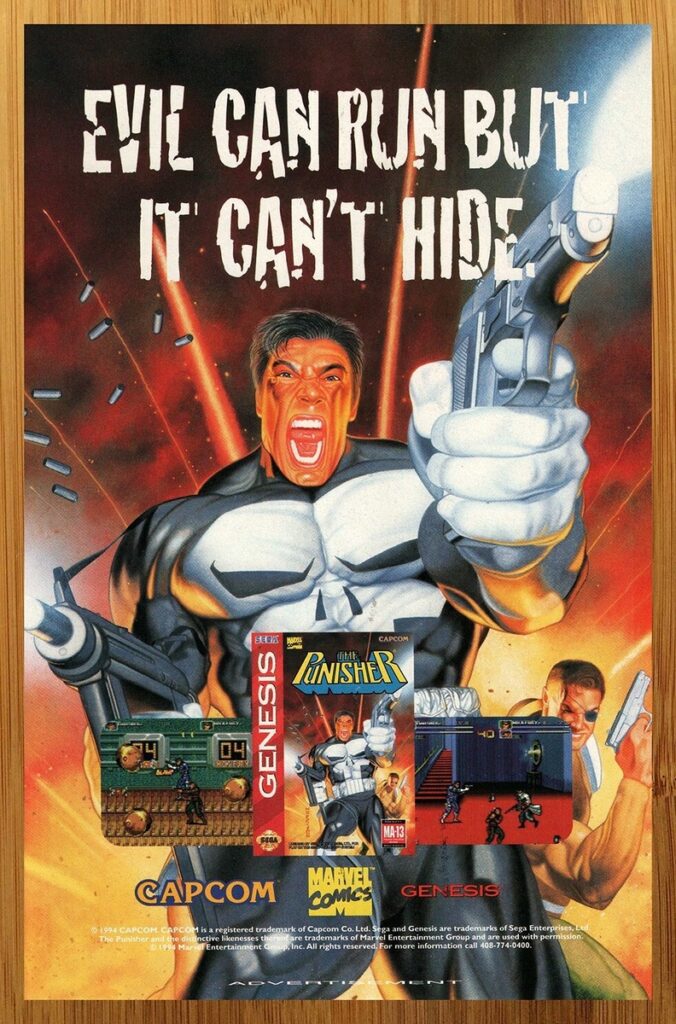
For Genesis owners, the home version represented something enormously appealing: the chance to bring that arcade chaos into the living room. No quarters. No crowd waiting behind you. No machine set to drain your allowance before the next boss.
The home conversion could not reproduce everything that made the coin-op game special. The sprites were smaller, the sound lost much of its arcade muscle, fewer enemies filled the screen, and several environmental details disappeared. Yet underneath those compromises is still a recognizable version of one of Capcom’s most distinctive brawlers—a shorter, leaner and noticeably rougher battle through Frank Castle’s war on crime.
From the Arcade Floor to the Genesis
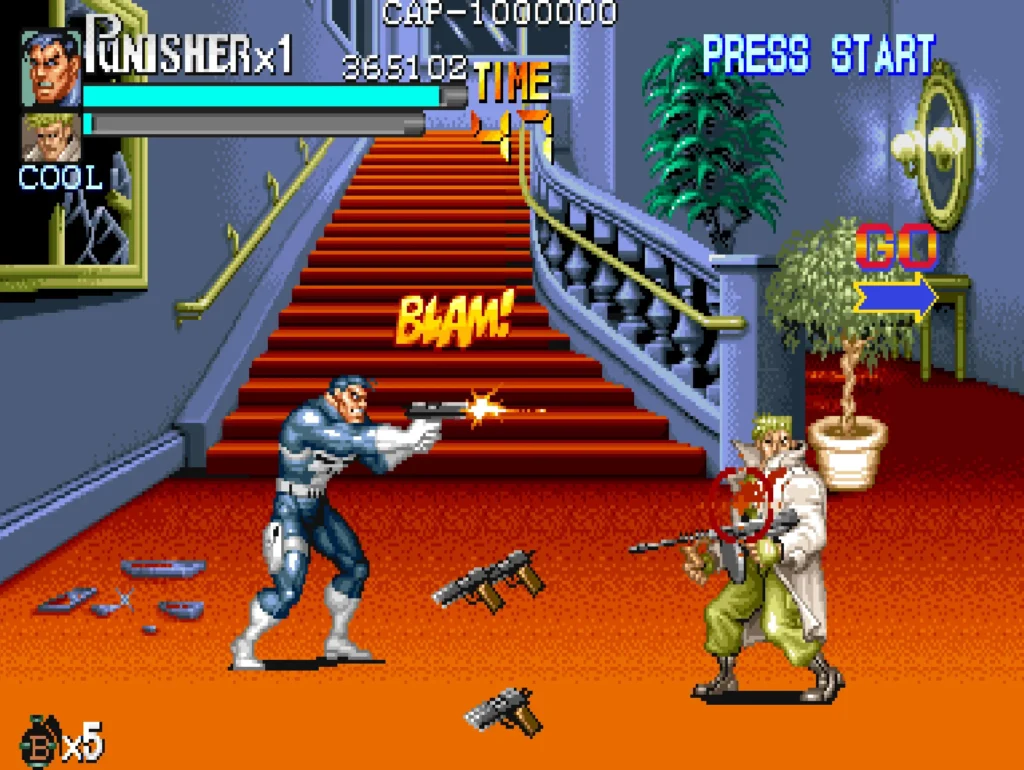
The original Punisher arcade game arrived in Japan in May 1993 and North America that July. Capcom developed it for its CP System Dash hardware, building on the side-scrolling formula it had sharpened through games such as Final Fight and Captain Commando. The Genesis port followed in North America in February 1995 and Europe that April. Sculptured Software handled the conversion, while Capcom published it.
That timing matters.
By 1995, the 16-bit beat ’em up had already lived a very full life. Genesis players had access to Streets of Rage 2, Streets of Rage 3, Golden Axe, Alien Storm, Comix Zone and countless licensed brawlers. Fighting games had also changed expectations. Players who had spent years walking right and punching groups of enemies were becoming fascinated by combo systems, special moves and competitive one-on-one battles.
The Punisher therefore arrived as both a welcome arcade conversion and something of a late guest.
But what a guest.
The comic-book license immediately gave it a different flavor from the average street brawler. Frank Castle was not cleaning up the city because a mayor asked nicely. His family had been murdered, and his campaign against organized crime was personal. Kingpin sat at the top of the criminal operation, while familiar Marvel villains including Bushwacker and Jigsaw helped give the journey the feeling of a playable Punisher comic.
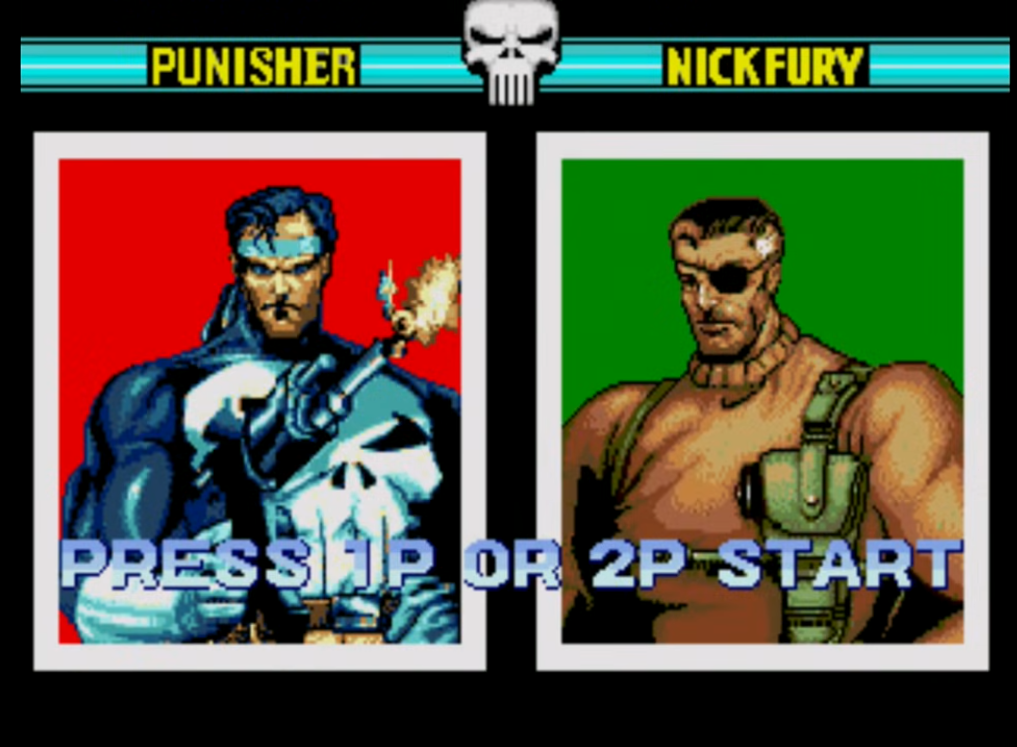
There was also Nick Fury, who joined the battle as the second playable character. The idea of Frank Castle and the cigar-chomping S.H.I.E.L.D. veteran tearing through a room together was pure early-1990s Marvel energy: stern faces, oversized firearms, endless ammunition and very little patience for negotiation.
What It Felt Like in the 1990s
Finding an arcade-perfect port was never guaranteed during the 16-bit era.
Sometimes the home version was shockingly close. Sometimes it was an inspired reinterpretation. Other times, you brought the cartridge home and immediately noticed that half the crowd, animation and background detail had vanished.
The Punisher sits somewhere in the middle.
The Genesis game preserves the structure, characters, stages and general personality of the arcade release, but it cannot recreate the same spectacle. That difference would have been obvious to anyone who had played the cabinet first. The arcade game could fill the screen with bodies, debris and frantic motion. It felt loud and unruly. The Genesis version feels more controlled and noticeably emptier.
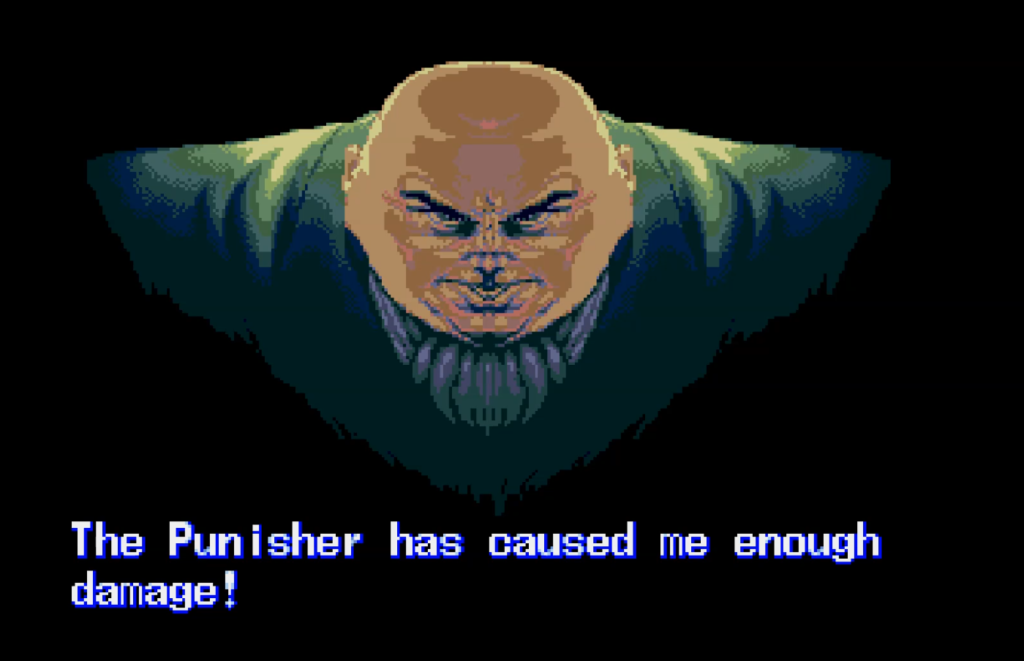
Even so, the basic fantasy survived.
For a player discovering the game through a rental store or borrowed cartridge, it was still a Marvel beat ’em up in which the Punisher could grab a criminal by the collar, pound him into the pavement, pick up a weapon and continue marching toward Kingpin. That was more than enough to make an impression.
It also belonged to a particular kind of weekend. A cartridge like this was perfect for a Friday-night rental because the rules were instantly understandable. One player took Frank. The other took Fury. You moved from left to right, cleared each mob, fought a boss and tried to finish the game before the rental had to be returned.
No lengthy tutorial was required. No memory card needed organizing. No update had to install. The game placed you in front of several criminals and trusted that the first punch would explain everything.
Gameplay: The Part Your Hands Remember
The Punisher follows the classic belt-scrolling beat ’em up structure. You can move horizontally across the stage and shift up or down to line up with enemies. Your normal attacks chain into a straightforward combination, while grapples allow you to strike or throw opponents. A desperation-style special move can clear space when a crowd closes in, though—as expected—it costs a portion of your health.
The movement and combat are easy to understand within seconds. There is an appealing rhythm to stepping into range, knocking one enemy backward, grabbing another and using a throw to create breathing room. Frank and Fury share broadly similar abilities, so choosing between them is more about character preference and co-op identity than mastering radically different move sets.
The game’s defining twist is its weapon system.
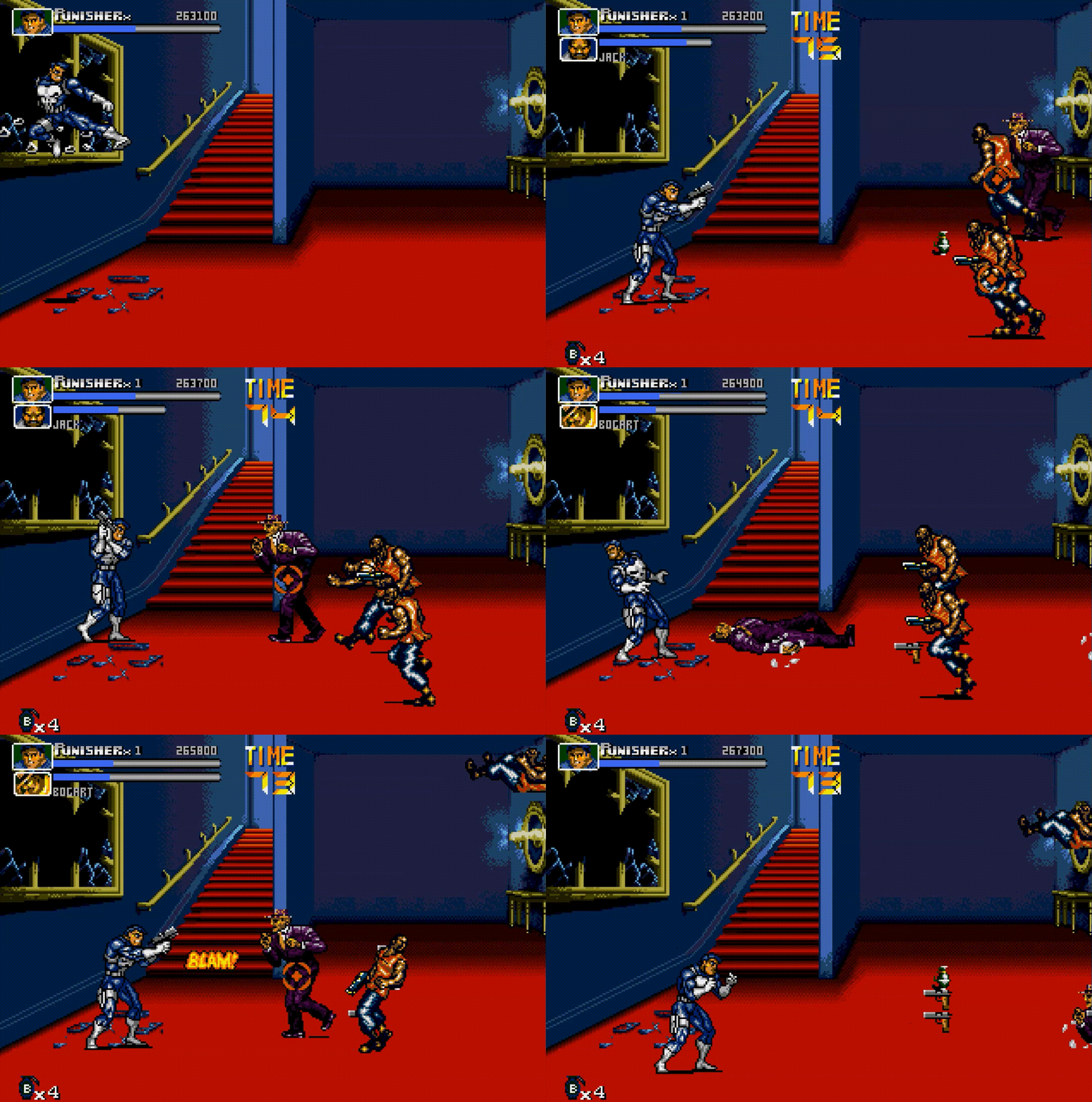
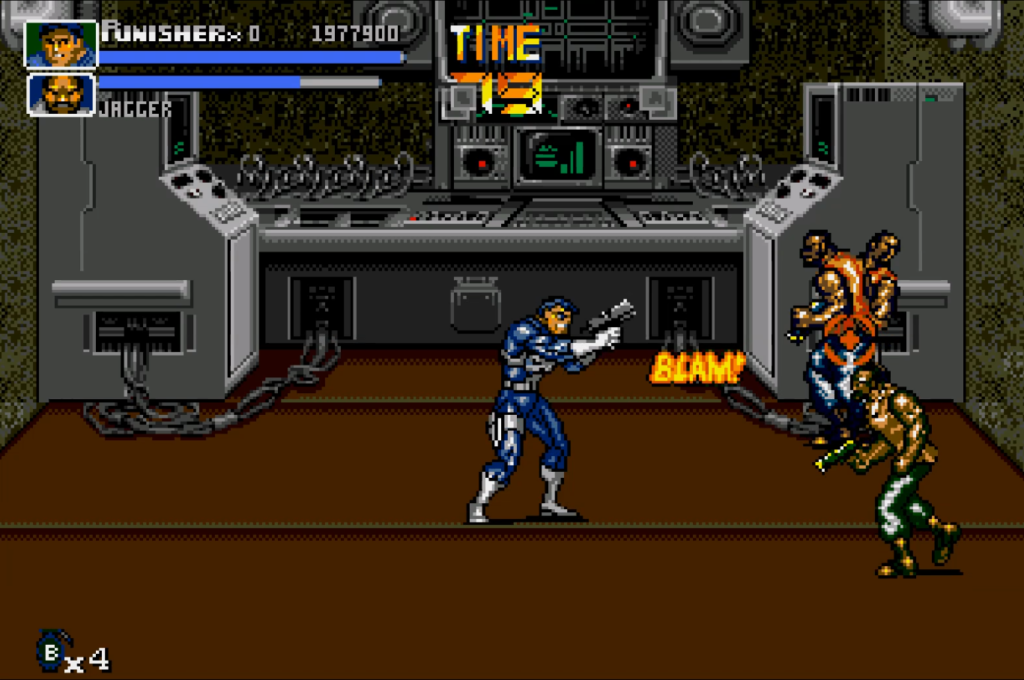
Baseball bats, swords, knives, axes, hammers and other objects can be taken from enemies or found throughout the stages. Guns receive special treatment. When firearm-carrying enemies appear, Frank and Fury automatically draw their pistols, temporarily shifting the action from close-range brawling to chaotic shooting. That change gives the game a personality few other beat ’em ups possess.
One moment you are trading punches in a corridor. The next, everyone is firing across the room.
The mechanic fits the Punisher beautifully. He is not a martial artist committed to honorable combat. He uses whatever will end the fight fastest.
The Genesis version also supports two-player cooperative play, which remains one of its biggest strengths. Solo play works well enough, but the game feels most natural with Frank and Fury sharing the screen. Beat ’em ups have always benefited from the small arguments and accidental comedy of couch co-op: fighting over a health item, grabbing the weapon your partner wanted or somehow leaving one player to absorb an entire enemy wave.
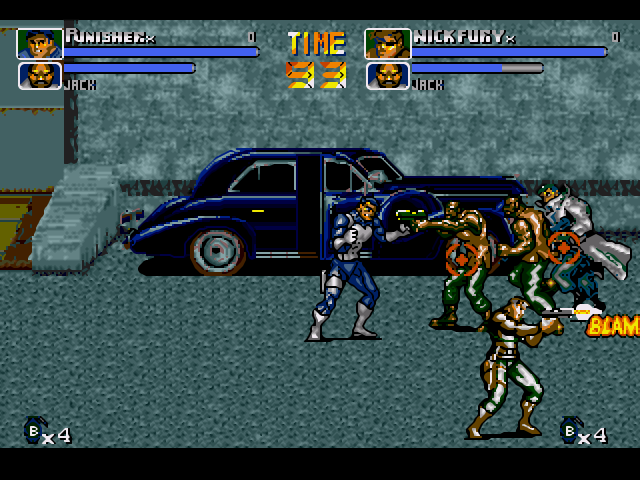
The difficulty, however, is thoroughly arcade-minded.
Enemies can surround you quickly, and bosses often rely more on pressure and endurance than clever patterns. Some encounters feel manageable once you understand the movement lanes. Others become wars of attrition in which losing health seems almost unavoidable. Three difficulty settings are included, but Easy mode ends after only three stages; seeing the full campaign requires Normal or Hard.
That is the kind of old-school trick that deserves a warning. Easy mode is less a complete relaxed playthrough and more a shortened practice run.
Graphics, Sound and Comic-Book Atmosphere
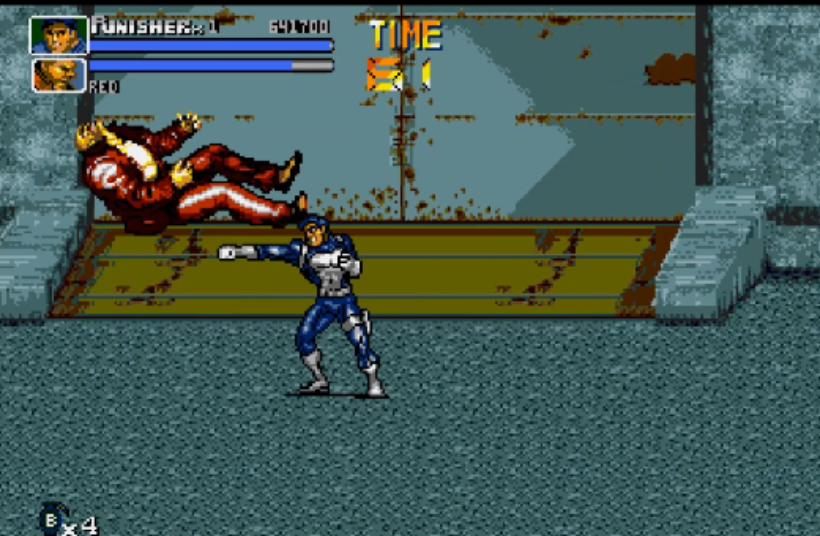
Visually, the Genesis conversion is clearly reduced from the arcade original. Characters are smaller, animation is less fluid and the stages lack some of the crowded environmental detail that made the cabinet feel so alive. Fewer enemies appear simultaneously, and many background objects that could be smashed in the arcade version are no longer interactive.
The color palette can also feel dark and muddy, especially when several enemies overlap against similarly toned backgrounds.
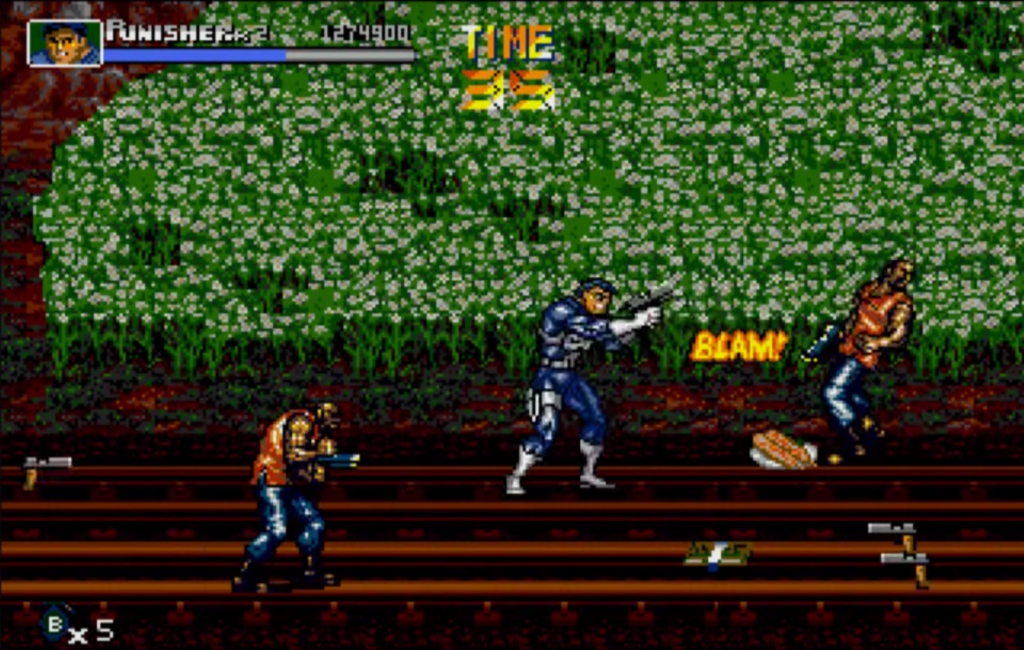
Still, the game does not lose its identity.
Frank’s black costume and white skull remain instantly readable. Nick Fury carries the square-jawed authority expected of the character. Kingpin looks appropriately enormous, looming over the final confrontation like a wall in a white suit. Comic-style illustrations and cutscenes help preserve the Marvel presentation between stages.
The environments move through illegal casinos, city streets, warehouses, waterfront areas and criminal strongholds. These are not cheerful comic-book locations. They are dim, industrial and full of people who have made the serious mistake of standing between Frank Castle and his objective.
The audio takes a harder hit.
The arcade game’s music and weapon effects had room to roar. On Genesis, the soundtrack is thinner, the impact sounds are less forceful and the overall mix does not generate the same sense of escalating mayhem. Contemporary reviewers frequently criticized the sound and presentation, even when they acknowledged the range of weapons and moves.
Yet the game still has the unmistakable crunch of a Genesis action title. The music pushes forward, punches land with blunt electronic thuds, and gunfire cuts through the stages with an abrasive urgency. It may not sound luxurious, but it sounds appropriately angry.
A Story Told Through Targets
The plot is pure Punisher.
Frank Castle’s family is murdered after witnessing a mob killing. Castle becomes the Punisher and begins dismantling the organization responsible, starting with Bruno Costa and working his way through Kingpin’s network. Nick Fury joins the campaign as the second playable character, turning the story into a two-man assault when another player picks up a controller.
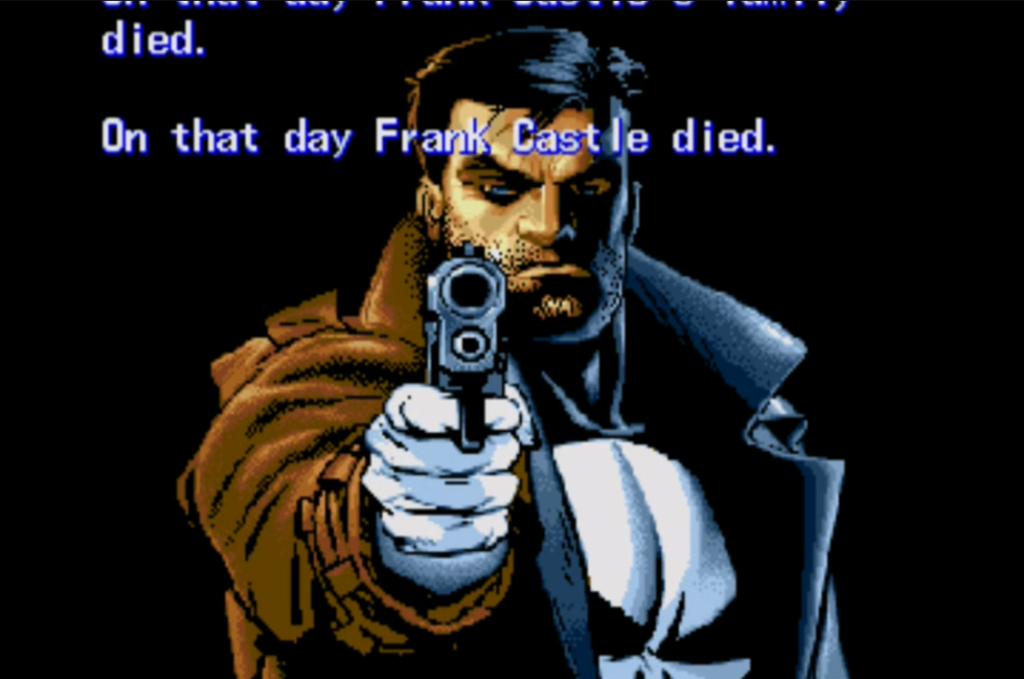
The storytelling is brief, but that suits the genre. Villains appear, information is extracted and the next destination becomes clear. The comic-book art and recognizable characters provide just enough context to make each stage feel like part of a larger criminal conspiracy.
The Genesis release tones down some of the arcade game’s violence. Explicit moments were altered, Fury’s cigar animation was removed, and certain enemy designs were made less revealing.
Those changes soften the edge, but they do not transform the game into something gentle. Frank Castle still solves almost every problem by hitting it, shooting it or throwing it into something breakable.
The Moments That Stick
The best memories in The Punisher come from its constant escalation.
A room begins as a fistfight. Then an enemy drops a sword. Another arrives with a gun. A grenade bounces into the crowd. Furniture breaks. A boss charges into view. Your partner takes the health item. Everyone starts shouting.
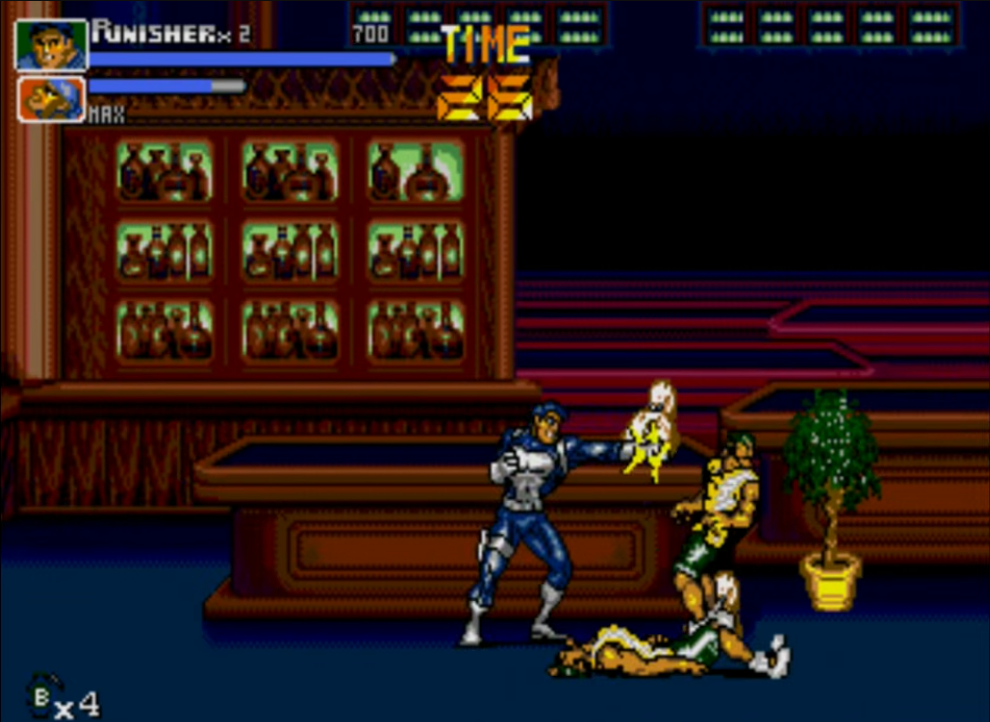
The game understands that a beat ’em up lives or dies through momentum. New weapons and enemy groups arrive frequently enough to keep the combat moving, while the firearm sequences provide bursts of controlled chaos.
The interrogations and comic-book transitions also help separate it from more anonymous brawlers. This is not merely a group of interchangeable heroes fighting a generic gang. It is Frank Castle hunting specific criminals, following a chain that eventually leads to one of Marvel’s most recognizable crime bosses.
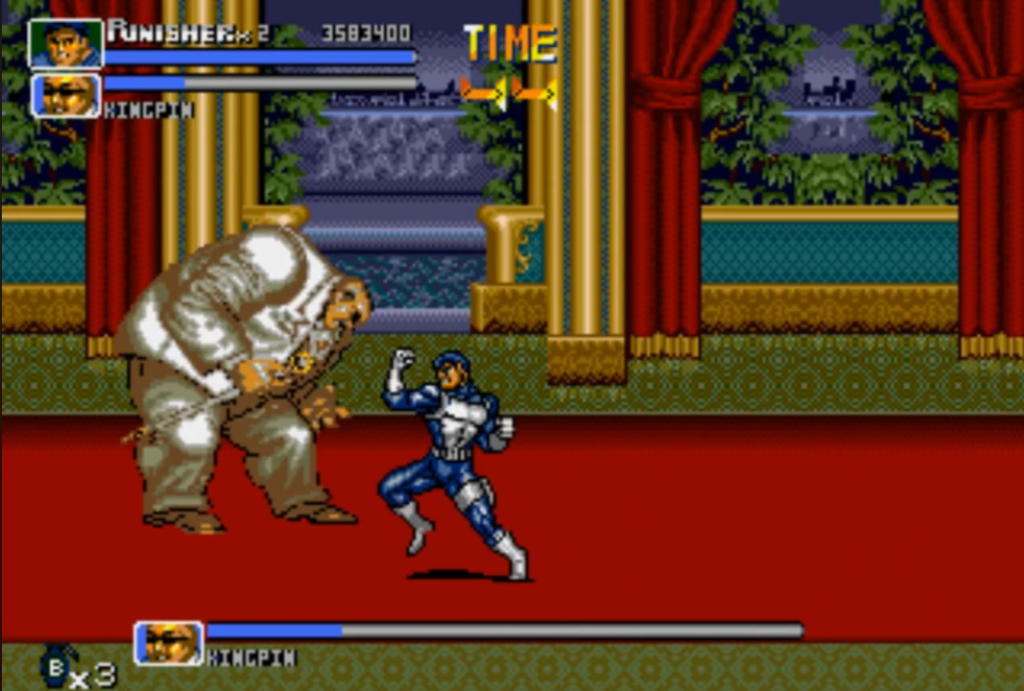
For many players, the Kingpin confrontation is the lasting image. He is huge, durable and visually dominant, exactly as a final boss should be. Reaching him on Normal or Hard feels like surviving a long, ugly night in which every mobster in New York received the same invitation.
Where the Genesis Port Falls Short
The harsh truth is that the Genesis version is not the definitive way to experience The Punisher.
It contains fewer enemies, less environmental interaction, reduced animation, weaker sound and censored content. The arcade game feels faster, fuller and more violent. When the two are placed side by side, the home version’s compromises are impossible to ignore.
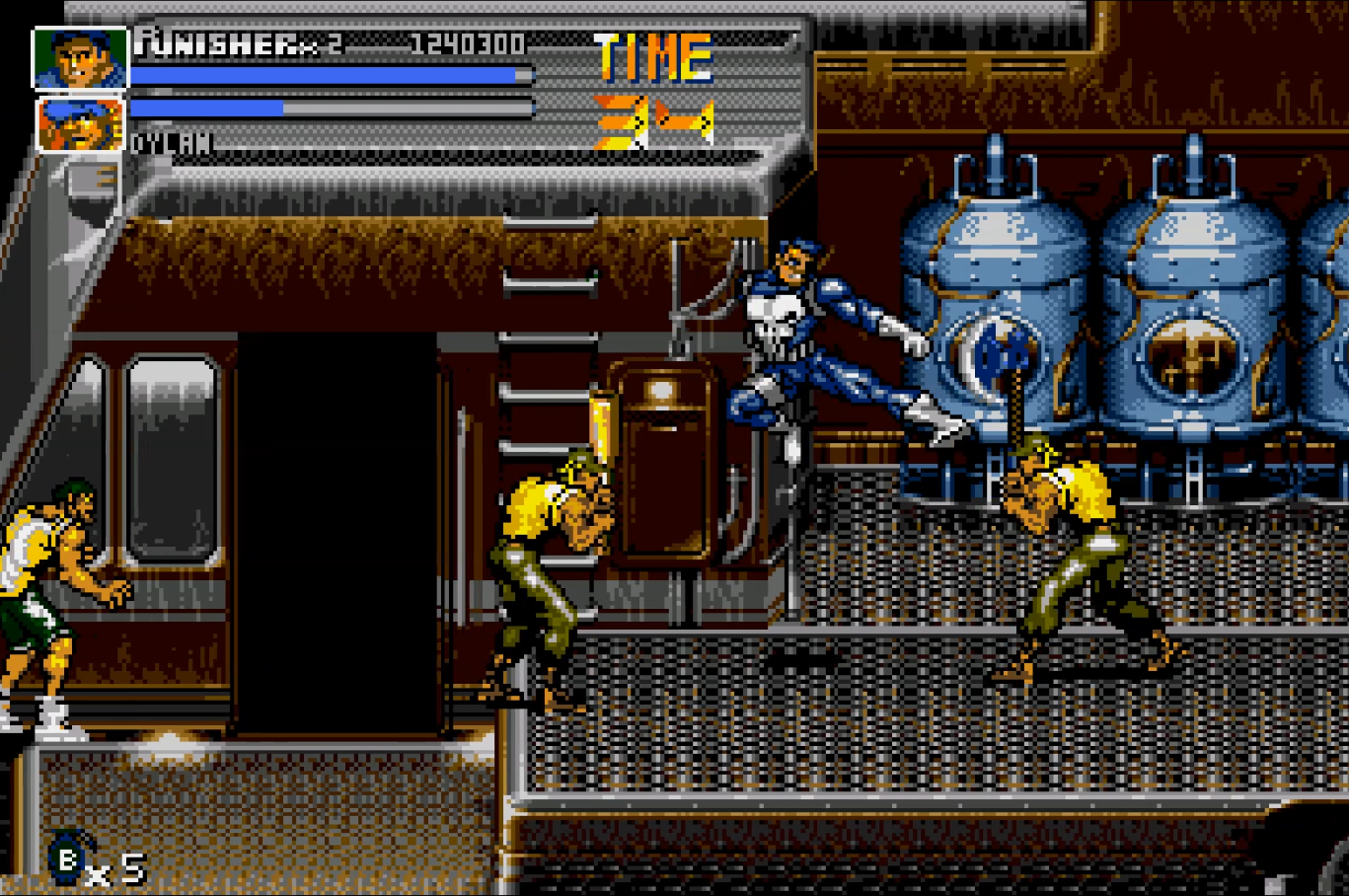
The combat can also become repetitive during a solo run. Frank and Fury are effective but not dramatically different, so the game lacks the variety offered by brawlers with larger casts. Boss battles sometimes lean on extended health bars and crowd pressure rather than memorable mechanical ideas.
The limited button use may initially make the action feel simpler than expected, especially for players coming from Streets of Rage 3 or later beat ’em ups with more expansive move sets.
Contemporary reception reflected these shortcomings. Some reviewers considered it a decent but conventional brawler, while others criticized the small characters, duller colors, weak sound and failure to match the arcade spectacle.
Those criticisms are fair.
But calling the port disappointing is not the same as calling it worthless. It remains playable, energetic and unusually faithful in its overall structure. Its biggest problem is that the original game it attempts to reproduce is substantially better.
Why The Punisher Still Matters
The arcade release occupies an important place in Capcom and Marvel history. It was an early product of the relationship that would eventually produce a long line of Marvel fighting games and the Marvel vs. Capcom series.
It also demonstrated how naturally comic-book characters could fit the arcade brawler format.
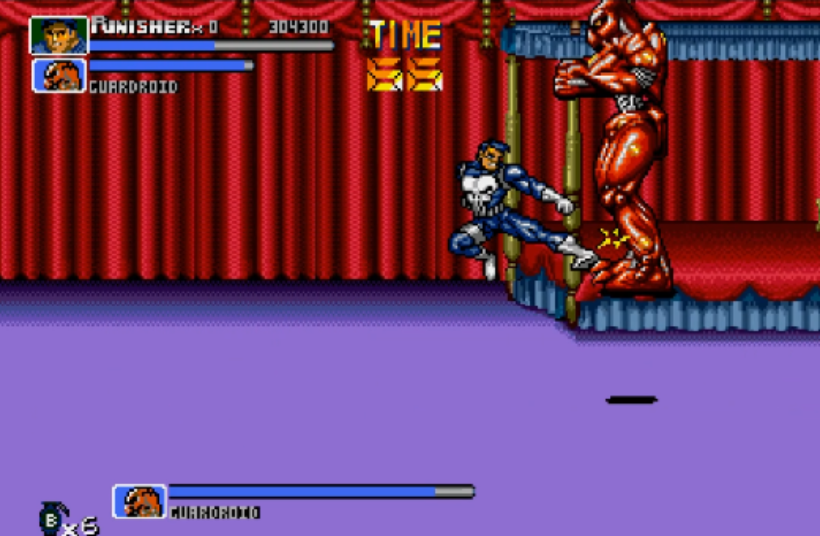
The Punisher did not feel pasted onto an unrelated game. Firearms, interrogations, brutal throws and the relentless march through organized crime all matched Frank Castle’s world. Even Nick Fury made sense as a cooperative partner in an era when multiplayer arcade action needed a second recognizable hero.
The Genesis conversion matters for a different reason. It was the only contemporary home port. For years, it was one of the few practical ways to play something resembling Capcom’s arcade game outside an actual cabinet.
That exclusivity helped transform an imperfect conversion into a desirable collector’s item.
Best Way to Play Today
The easiest legitimate way to experience the game now is through Marvel vs. Capcom Fighting Collection: Arcade Classics. Released in 2024, the collection includes the original arcade version of The Punisher alongside Capcom’s major Marvel fighting games. This is the version most players should choose. It retains the arcade presentation, provides convenient modern access and does not require spending collector-level money on one cartridge.
The Sega Genesis cartridge is a different proposition.
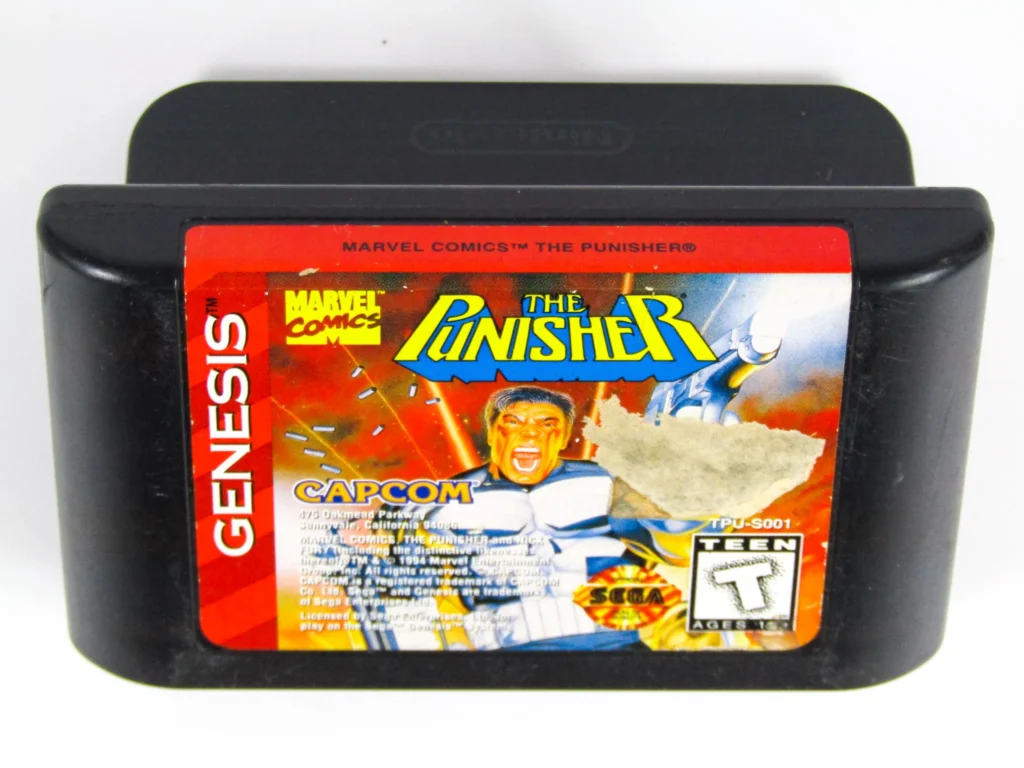
As of July 2026, PriceCharting estimates the North American version at roughly $105 loose and more than $400 complete, although actual selling prices fluctuate with condition, authenticity and demand. The PAL Mega Drive release is dramatically more expensive and should be treated as a serious collector purchase rather than an economical way to play.
Collectors should also watch for reproductions. Examine the cartridge shell, label, circuit board, box and manual carefully before paying premium prices. A listing being expensive does not prove it is authentic.
For most readers, the practical advice is simple:
Play the arcade release through the modern collection. Buy the Genesis cartridge only when owning that specific conversion means something to you.
A six-button Genesis controller, a quality HDMI solution for original hardware and a protective cartridge case can improve the physical experience, but none of them turn the console port into the arcade game. Spend according to the memory you are buying, not the promise of a perfect conversion.
The Modern Revisit
Today, The Punisher on Genesis is best approached as a fascinating home adaptation rather than a lost masterpiece.
The core combat remains immediately accessible. The weapons still give each stage a welcome sense of improvisation. Two-player mode still turns an ordinary evening into a miniature arcade session. The Marvel setting still supplies personality that many forgotten brawlers never possessed.
What requires patience is the repetition, the reduced spectacle and the arcade-style difficulty. New players may also struggle to understand why collectors pay so much for a cartridge that is demonstrably inferior to the version available in a modern collection.
The answer is that retro collecting is rarely based on utility alone.
The cartridge represents a particular promise: bringing Capcom’s Punisher cabinet home during the final years of the Genesis. It represents rental-store discoveries, Marvel comic racks, arcade conversions and the thrill of seeing a game that once swallowed quarters running through a console beneath the television.
That history has value.
It simply should not be confused with value for money.
Final Takeaway: A Scarred but Memorable Homecoming
The Punisher on Sega Genesis is a compromised port of a terrific arcade game.
It is smaller, quieter, less violent and less crowded than the coin-op original. Its bosses can be cheap, its combat eventually repeats itself, and its collector price is difficult to justify for anyone who merely wants to play.
Yet Frank Castle’s identity survives the conversion.
The guns, improvised weapons, comic-book villains, two-player mayhem and relentless forward motion still give the game an attitude of its own. It preserves a time when bringing an arcade title home meant accepting losses, using imagination to fill the gaps and appreciating that the experience had escaped the arcade at all.
Players looking for the best version should choose the arcade release in Marvel vs. Capcom Fighting Collection. Genesis collectors, Marvel devotees and fans of late-era brawlers may still find the cartridge deeply appealing—provided they understand exactly what they are paying for.
People remember The Punisher because it captured something wonderfully direct about both its hero and its era. The screen filled with criminals. Frank Castle walked in. The music started.
And for the next half hour, absolutely nothing in the room was safe.